What the Jobtech for Refugees Summit learned about turning training into real work.
Compiled by Brenda Nambatya (Jobtech Alliance) and Lorraine Charles (Na’amal).
Across three sessions, the Jobtech for Refugees Summit set out to answer one question: what does it take to turn training into a sustained livelihood?
One finding held. The refugee employment pipeline breaks in the spaces between the actors meant to connect training to work: between skilling and placement, between employer interest and a signed contract, between a certificate and a sustained income.

The Jobtech for Refugees Summit brought businesses, jobtech platforms, lenders, training providers and refugee-led organisations into one honest conversation about why trained refugees so often stop short of work, and what it takes to carry a ready person all the way through to a livelihood. This report is what surfaced.
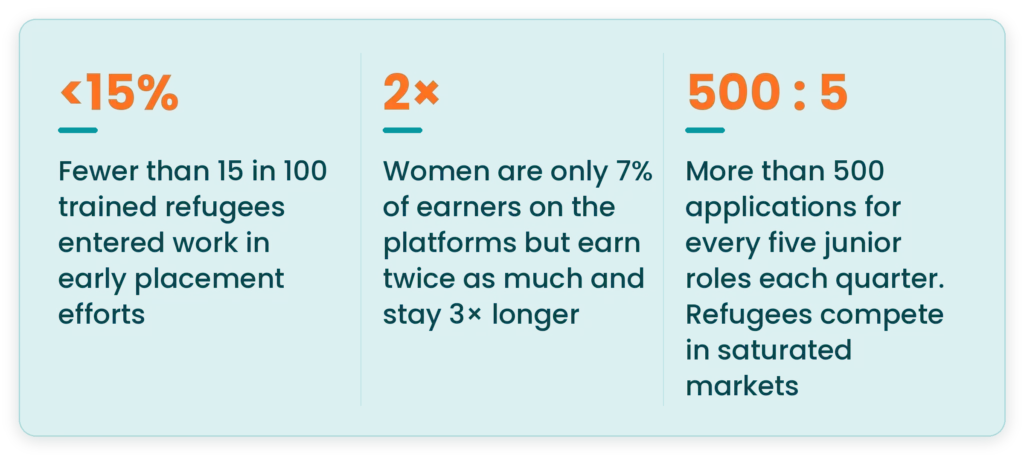
Three gaps, one pipeline
The summit surfaced three connected gaps, each a place where a promising pathway quietly stops. The report walks through all three with candid examples from businesses and platforms, then sets out what to do about them.
- The conversion gap. Completing training rarely leads to sustained work on its own. Placement, documentation, devices, finance, and early retention decide who actually earns.
- The demand gap. Employers say they support refugee inclusion. Whether they hire is a separate question, shaped by real roles, compliance, cost, speed, and who inside the business owns the pathway.
- The work mismatch. Training keeps expanding while the work it prepares people for keeps moving, and AI is changing what entry-level work exists here in Africa.
Inside you’ll also find the demand-led hiring model that worked, why women’s participation stays low while their performance runs high, and recommendations for donors, training organisations, employers and platforms, intermediaries, and refugee-led organisations.
One of the summit’s most provocative propositions: refugee employment programmes may be training the wrong people for the wrong opportunities.
About the summit
The Jobtech for Refugees Summit ran online from 23 to 25 June 2026, convened by the Jobtech for Refugees Community of Practice, led by Na’amal and Jobtech Alliance.
Around 100 people joined each of the three sessions, with contributors including Amazon Web Services, Inkomoko, SafeBoda, Elewa, Konexio, Accion, EzyAgric, and Ecoplastile.