
I turned 40 last week. My back hurts. My hair is thinning (or would be if I hadn’t gone to Turkey 😂). I’m old.
Age and experience do, however, bring some benefits. I giggled the other day when I was introduced in an email as a “wise sage”. While I scoffed at the term, the truth is that few in Africa could be classed as ‘sages’ of the jobtech sector. No one has been taught ‘by their mother’ about how to create platforms that create livelihoods in Africa. There is no university course on the jobtech sector, or youth employment for that matter (though there is an e-learning course thanks to our friends at The Flip/VC4A!). Instead, social entrepreneurs have been taught by the cold, hard surface of the world. Luckily, we’ve been there to witness some of the remarkable achievements of the jobtech sector in Africa over the last five years, and some of the failures.
This month, we launch Phase 2 of the. In Phase 1, we built a community representing more than 600 platforms operating in more than 40 countries in Africa, and we worked hand-in-hand with more than 50 platforms. From this work, in addition to tracking monthly earnings of over a quarter of a million platform workers in Africa, has afforded a wealth of learnings about how the jobtech sector works in Africa. These lessons have taught us both about how platforms interact with user livelihoods in Africa, and how to build platforms better.
Many of these lessons were shared in our 172 learning products and at our 120 events (that were consumed by more than 144k people). But while some of these insights were time-bound (either based on a current trend, or which were disproved later), other learnings were only reinforced the more data points we collected.
We’ve written these lessons up into the Ten Commandments of Jobtech. Each of these is waiting to be proven wrong, but have held up against the experiences accumulated over the last half-decade. We can’t wait to disprove some of these and learn new ones in the next half-decade. Get in touch if you want to collaborate!
Into old age, and beyond!
Chris

📖 Our insights
A gig worker’s ratings, reviews and earnings history has value beyond the platform where it was earned. Our new learning study with GigCV sets out what data portability makes possible, and what it takes to build it. Over 100,000 workers have already accessed their data through GigCV.
Inside: four platform case studies, survey findings from 500+ data workers, and a founder starter kit.Read the study.
📣 We need you
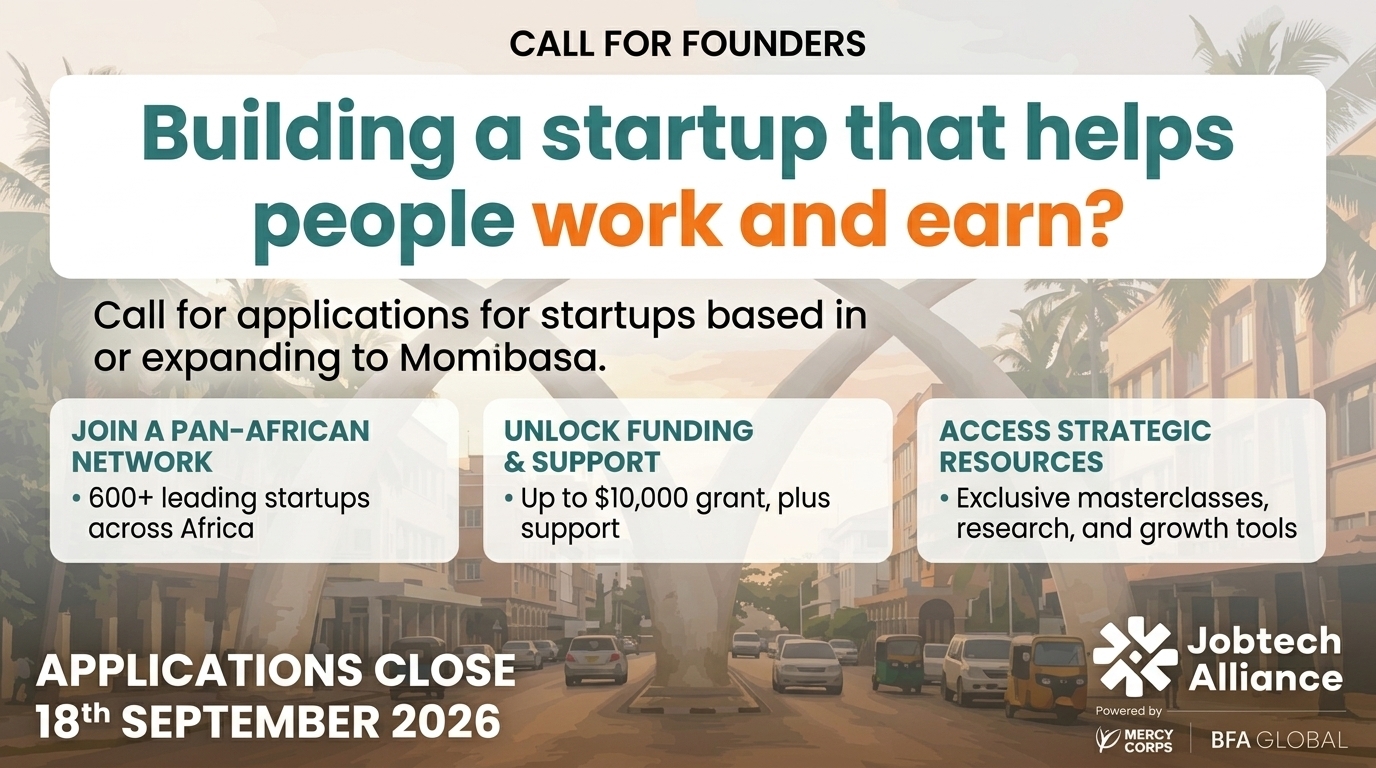
Are you building a jobtech platform in Mombasa or looking to expand to Mombasa? We want to meet you.
is launching in Mombasa and looking for founders whose platforms help people find work, train for work, or earn a living. That includes platforms connecting people to deliveries, trades or care work; freelancing and remote work tools; training that leads to paid work; and digital services for small businesses.
What you get: a network of 600+ founders across Africa, up to $10,000 in funding and technical support, masterclasses on pricing, retention and unit economics, and access to our research on digital work here in Africa.
No fee. No equity. No minimum revenue. If it is live and people are using it, apply.
Applications close 18th September, 2026. If you know someone who might be a fit, do share this with them; we would love to have them.
🗞️ Who’s making the news
Platforms for offline work
- Lagos-born Moove has closed a $250 million Series C at a $2.1 billion valuation, becoming Africa’s newest unicorn and only the second jobtech platform to reach that milestone after Andela!
Moove built its business by financing vehicles for ride-hailing drivers who couldn’t access traditional credit, using earnings data from ride-hailing platforms to assess them instead. The company now operates around 42,000 vehicles across 29 cities in 13 countries. It signals that platforms solving structural barriers to work, rather than just aggregating labour, can attract serious global capital. The new funding is earmarked for autonomous vehicles and fleet depot facilities. The model is evolving, but it started with a driver who couldn’t get a car loan. More on the story here.
Digital tools for worker enablement
- South Africa’s Jem HR has raised $8.4 million in a Series A round led by Quona Capital. The WhatsApp-based HR and benefits platform serves 250,000 frontline workers across 200 companies in South Africa. Employees without email can access payslips, request leave and manage financial wellness products, all via WhatsApp. The funding will support its expansion into a full workforce management platform.
📆 What’s on our calendar
-2.png)
On 3 September, the people who helped us select all 52 platforms we have backed come together.
Founders, investors, skillers, accelerators and researchers; all of them with years of jobtech experience here in Africa under their belts. Ten commandments.
Ten voices who have supported the businesses building livelihoods share their learnings.