Uganda, known for its progressive refugee policies, hosts over 1.5 million refugees from countries like South Sudan, the Democratic Republic of Congo, Somalia, and Burundi. Out of these, over 140,000 are present in the city of Kampala itself. Despite Uganda’s welcoming policies, many urban refugees struggle to secure sustainable livelihoods due to limited access to formal employment, language barriers, social discrimination, and lack of documentation, often forcing them into precarious work. At the same time, there’s a global phenomenon where refugees and migrants are disproportionate users of jobtech platforms, which provide unique access to and infrastructure for work that can be difficult for refugees to gain access to otherwise. We have delved deeper into this topic as part of our earlier research – the Kampala case study
At the Jobtech Alliance, under our Jobtech for Refugees project, we have focused on creating job opportunities for urban refugees in Uganda by leveraging jobtech platforms to empower them economically. In addition to providing venture support to platforms, we worked with Refugee-Led Organisations (RLOs) to equip refugees with information and skills to access the opportunities on jobtech platforms. The goal was to provide tools, training, and support to integrate refugees into the digital labour market.

After a year of implementation, we’ve struggled to achieve the desired results; we have worked with eight platforms and engaged hundreds of refugees, but still only a handful of refugees now have quality jobs (as defined by Jobtech Alliance’s standards). This blog delves into our experiences, lessons learned, and areas where our initial approach fell short, leading us to develop a new supply-side strategy that we believe will achieve our desired outcomes. We introduce our new operational model and highlight the shortcomings of our initial pilot projects and approach.
Reinforced learnings around working with the private sector and refugees
As the Jobtech Alliance, our focus and nucleus has always been platforms, and we believe that scaling viable platforms is the most important step to generate demand for workers and create employment opportunities on the continent. This seems obvious – if platforms do not have good jobs, or good enough offers, they are never going to appeal to the refugee community. Our original hypothesis was that the greatest failure of many refugee programs was a failure to adequately work with the private sector. ‘If we work effectively with jobtech start-ups to enable them to create more jobs for their users,’ we thought, ‘we can connect refugees to these opportunities by collaborating with RLOs to identify, capacitate, and onboard refugees onto the platforms.’
The hypothesis was partly proven correct; we indeed found that, if platforms were not offering sufficient value for refugees, they would not take up the opportunities sustainably. For example, when we first started working with one Ugandan platform that connects skilled micro workers to gig opportunities in digital work like web and graphic designing, we found that a lack of available jobs was the core problem; we found refugees with the requisite skills and onboarded a number onto the platform as part of a pilot, but observed that few gigs were assigned to our target group due to a fundamental lack of demand on the platform. This demoralised the cohort and led to low conversion rates on the platform. That is when we decided to also pivot and address the real problem: coupling demand–generation support for the platforms with the supply side (refugees) integration support. Similarly, we worked with one e-commerce player to integrate refugees as social sellers, but found that the commission offerings weren’t appealing to the refugee community, so the pilot never took off.
This reinforces our starting point that the quality and viability of the job offering needs is central to achieving sustainable change in refugee livelihoods; while training programs can enable engagement through stipends, sustainable jobs will only be achieved by having a truly strong offering.
However, we also found that, even when we worked with platforms to ensure sufficient quality jobs on the platforms, we were struggling to effectively onboard refugees into those opportunities; we have seen drop-offs of refugees due to various reasons, from high expectations versus realities, to access to assets, mismatched skills, and beyond. Trust has also been a consistent cross-cutting factor, as it requires significant investment to build trust in these very new and innovative platforms. Due to this myriad of issues, our supply-side engagement was insufficient; we needed to do much more than merely identify interested people through RLOs and onboard them.
This suggests that when it comes to engaging refugees on jobtech platforms, while it requires significant private sector engagement, results will not be achieved at scale if it is entirely private sector-led. The supply-side component is critical. In response to the lessons that we’ve learned, we’ve redesigned our supply-side engagement with refugees; this blog seeks to share our new supply-side model.
Introducing the funnel
In exploring the key areas (and failures) in our recruitment and onboarding of refugees onto jobtech platforms, we articulated a recruitment funnel that we’re using to structure our ongoing (and upcoming) engagements with refugees. This funnel details the stages a candidate progresses through to secure meaningful employment. Each platform has its own funnel, as each platform has unique opportunities and needs for refugees.
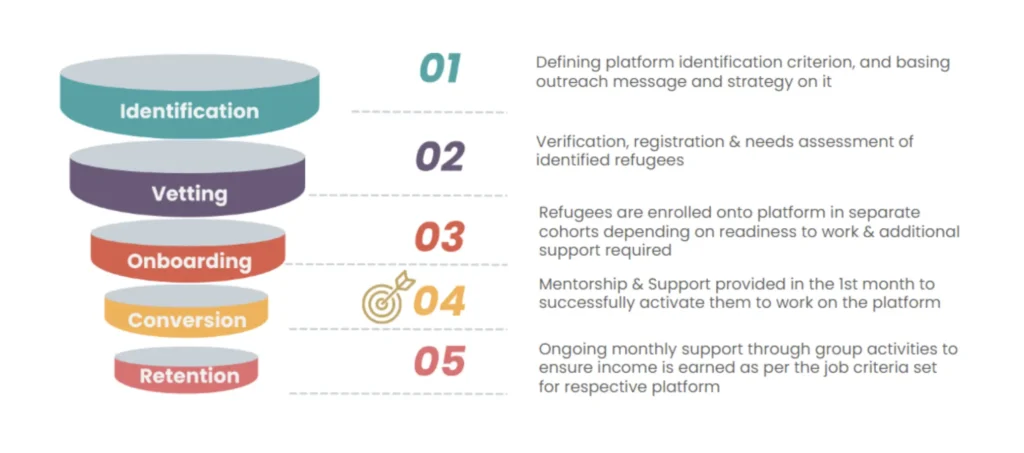
The rest of this blog explains some of our failures along this funnel, and what we’re doing about it.
1. Identification

Working closely with RLOs, we made a couple of mistakes identifying the right people for the right opportunities. We realised that identification cannot simply be based on what the platforms ask for in terms of hard/soft skills or equipment requirements (laptop, mobiles, bodas, etc.); they also need to take into account the personas and temperaments of the workers.
For example, Rwazi, a data collection platform that utilises mappers to collect live on-the-ground data, has an extremely simple selection criteria: the users need to have a mobile phone and a bank account or mobile money account to transfer funds. Using this approach, we initiated a pilot by onboarding a small set of refugees using basic selection criteria but found that some refugees either didn’t understand the opportunity, had expectations of NGO subsidy, or the opportunity was not suitable for them.
“Getting 0.1$ for taking photos and interviews in a shop is not lucrative enough for me,” explained Benjamin, a refugee mapper part of the pilot cohort. As we have worked with Rwazi extensively, we know that the platform offers lucrative income for thousands of young people across Africa, but we had not communicated the offering well to refugees, who may not have had experience working on per-gig jobs (‘if you complete X number of jobs, which will only take Y hours, you’ll earn UGX Z’). Another, who had gone through multiple NGO programs, expected subsidisation from the program, which we had not sufficiently emphasised would not be happening: “We were expecting at least data, airtime and some lunch arrangements from the platform to help us do our jobs.”
When over 90% of refugee users dropped off between onboarding and conversion, we realised we had to stop and reassess. We needed to better understand the refugee persona and expectations. Platforms appeal to people based on their needs, interests, expectations, livelihood opportunities and other responsibilities, and we need to consider those aspects when connecting candidates to platforms. For Rwazi, this would mean augmenting the selection criteria with the persona based on another set of factors.
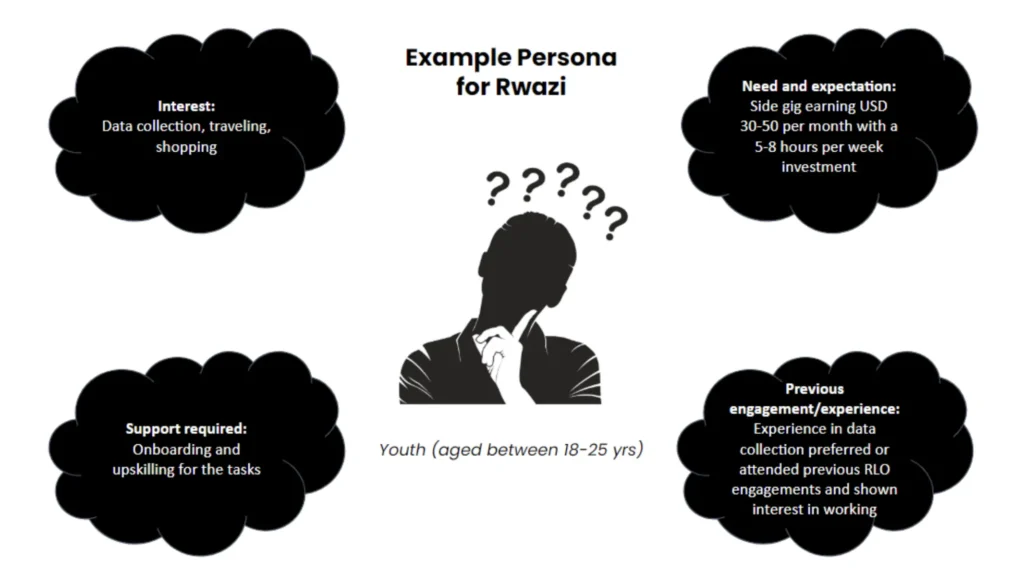
Describing the opportunity and earning mechanics during outreach, and then reiterating it during the vetting stage, is another crucial step to gauge if the opportunity aligns with refugees’ requirements. Jobtech platform users often have high expectations of what platforms offer, and refugees, who in particular may not have interacted with such platforms, need upfront clarity on what the likely returns are and the payment terms. “They should make the payments immediate so that the mappers are motivated,” added Benjamin. The right messaging for outreach is key.
Therefore, as a part of the new strategy, we decided to split and standardise the identification process into two steps: 1) creating an identification criterion and 2) defining the most effective message and strategy for outreach. The identification criterion not only includes the hard and soft skill requirements from the platform, but also other relevant skill sets that might be useful for the gig, augmented by supply-side metrics that would be known to the RLOs (like candidate’s interests, needs and expectations, previous work and experience and support requirement). Once defined, this criterion will be used to reach out to the right candidates, and the right strategic mix of channels – both physical and digital.
2. Vetting

Our private-sector-led approach meant that the platform was responsible for vetting the selected candidates, which led to a high churn among those who didn’t satisfy the needs of the platform, exacerbating the low morale of the identified cohort.
While this was an anticipated key stage in our supply-side engagement, we weren’t doing enough in terms of ‘pre-vetting’ and/or in using the opportunity to ensure alignment of expectations from the refugees (see above).
Therefore, as part of the new strategy, we decided that along with vetting their technical/soft skills and assets, we will also be vetting the alignment of the opportunity with their interests and needs. This will be done via an in-person assessment of the requirements through tests and interviews, followed by a more comprehensive briefing around the earning potential, expectations, and the optimised mechanics of earning.
3. Onboarding

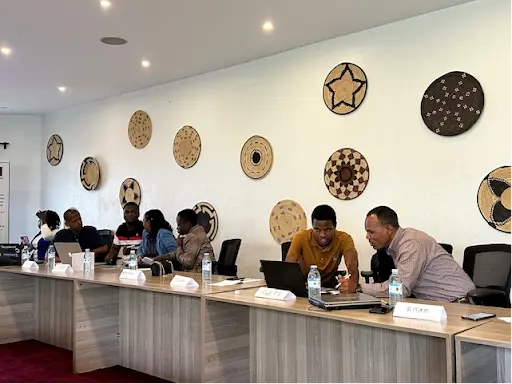
We had expected that onboarding (the process of getting someone signed up for the platform) would be one of the trickiest areas of our engagement. Refugee IDs are often not accepted in digital forms, and refugees may lack IDs entirely. This indeed proved to be the case. With Appen, a global microwork platform that offers data annotation opportunities to earn money, there were certain approval issues, starting from acceptance of identification documents to delays in getting the screening results from the platform. After our first pilot, we realised that there was a need for extensive guidance to support the refugees throughout the onboarding process. This included curating platform-specific interventions like webinars to help answer queries, while being in constant touch with the platform offline to resolve onboarding issues. It also meant refugee-facing interventions like regular offline engagements to walk refugees through the onboarding procedures.
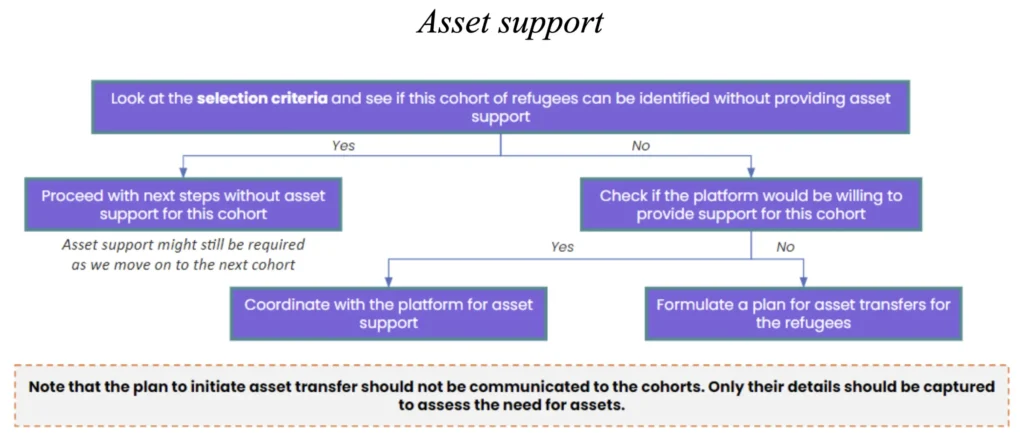
ID approval wasn’t the only problem that arose in onboarding. While we had expected to need to do training and consider asset access in some cases, we hadn’t considered the full extent of social aspects around this. For example, the popular ride-hailing app in Uganda, Safeboda, requires the driver to have a mobile phone. This can be prohibitive to refugees and those who don’t have access to a phone. While we introduced an accommodation plan for Safeboda to provide phones to those who lacked one, paid off by subsequent work on the platform (with Jobtech for Refugees covering the risk in the backend), after this possibility was introduced, we saw a drastic increase in those who claimed to need phone financing. Additionally, a new cohort of potential users came forward with an interest in the platform, who hadn’t previously been interested. We could no longer easily track who had genuine interest in the platform versus those who were interested in receiving a phone for ‘free’. We’re responding to this by introducing cohorts based on need, and utilising (and tracking) referrals from cohort to cohort.
Overall, we’ve split the onboarding process into three parts – upskilling, asset transfers and enrollment on the platform. Each of these processes is coupled with the other and has a defined flowchart, minimising the turnaround time and inconsistencies between these processes.
4. Conversion & Retention
Probably our most interesting insight came in conversion. While the earlier steps in the process can be difficult, conversion (getting the user to complete job(s) up to the point that they will continue utilising it) is probably the most challenging (and the most crucial step) in the funnel, and was probably the area where RLOs can be critical.
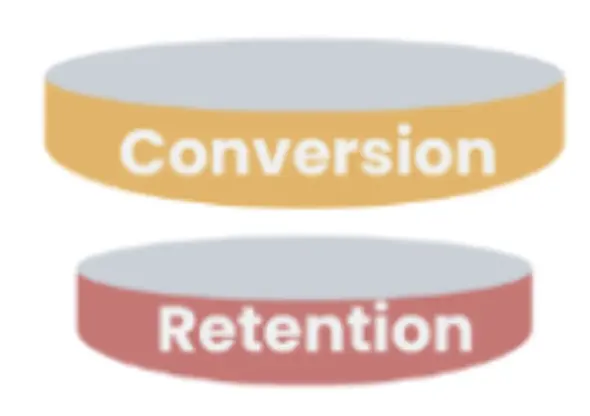

Conversion is traditionally seen as ‘how effectively a company converts its qualified leads into actual customers,’ and while it is often defined as a first purchase or gig, we have learned that jobtech platforms have a much more nuanced requirement to turn a user into an ‘actual customer/user.’Most platforms have a ‘critical point’ at which a user is likely to be retained into a regular user. It could be the first gig done on the platform within the first few days of onboarding, or a combination of multiple gigs done in the initial weeks. In the case of Rwazi, refugees found that their mapping work was being rejected. The quality of their pictures was not optimal, so they faced initial rejections. Disheartened by this failure, they lost confidence in themselves and the platform, and eventually opted out of the gig. Instead, we realised what they needed was someone (an existing super mapper on the platform/representative from the platform) who could mentor them through the first few gigs – show them an ideal mapping gig, the right way to capture the pictures for verification, how to collect money, and to tell them about the best practices and typical ‘hacks’ around doing the job.
Therefore, at the conversion stage, we introduced a new metric – conversion criterion. This is defined for each platform separately depending on the characteristics of the gigs offered. It represents how many gigs and in how many days it is required for refugees to get converted onto the platform. For Rwazi, we defined the conversion criterion as being able to map five shops within the first two weeks and decided to have a mentor guide each refugee for this period to accomplish the criterion. We believe this could take the conversion rate over 50% and consequently help build retention on the platform.
The final stage in the funnel is the retention stage. Where the conversion stage required a high level of support, the retention stage would require a medium to low level of support through a regular check-in cadence with the refugee cohort. This eventually leads to the creation of what we define as a job (refer to our previous blog on ‘What is a job’). It is important to seek out and address recurring challenges that pop up throughout the retention period and discuss them with the platform to discover the best solutions to these challenges. Eventually, we let the market approach play out as the refugees get comfortable working on the platform and successfully create a sustained livelihood for themselves.
Next Steps
As we pivot to this new supply-side strategy, we are buoyant about the outcomes it could present in the coming months. Breaking the refugee recruitment cycle into these stages and tightening them up will help us analyse any problems that pop up through the funnel and come up with the most efficient solutions. Have we optimised this cycle completely? Maybe not. But we are excited and hope to get new learnings out of it. Stay tuned for further updates!
The author is a Venture Building Extern at the Jobtech Alliance