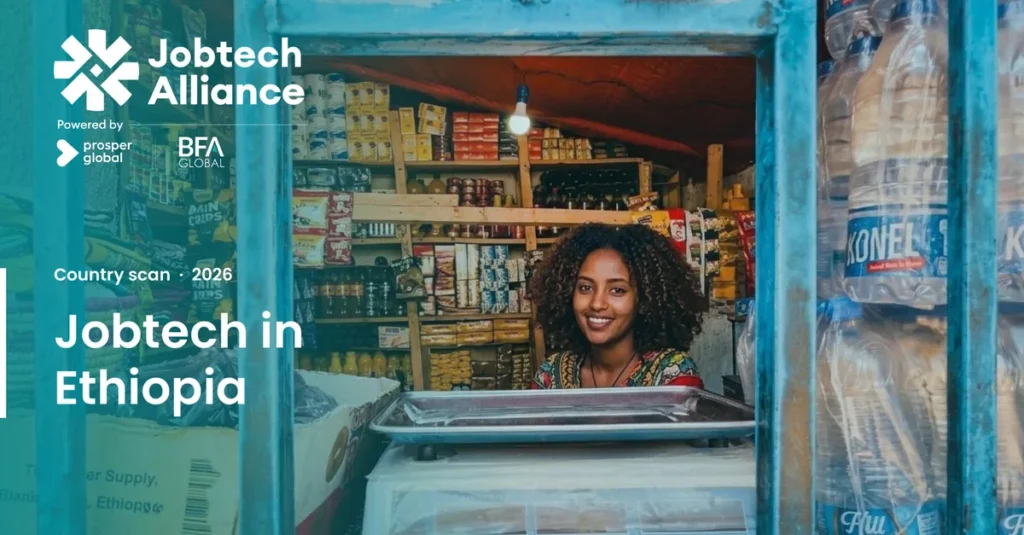
More than 2 million young Ethiopians join the labour market every year, looking for work. Some find it through a platform: driving with RIDE, delivering by bicycle for beU, or answering a job post on Afriwork. Jobtech in Ethiopia is young and still finding its shape. Our 2026 country scan maps 73 platforms and shows what the ones that work have in common.
1-click PDF download, 24 pages, 6MB
2M+
young Ethiopians join the labour market every year
85.2%
of workers are informal
73
jobtech platforms mapped
~15,000
people work in outsourcing (GBS and BPO)
A market building its own playbook
For years, Ethiopia sat apart from much of Africa’s tech scene. Telecoms were closed to competition, mobile money came late, and investors mostly looked elsewhere. That is changing. Telecom competition, mobile money and the Fayda digital ID are opening up Africa’s second-largest population to digital work.
Ethiopian founders are building for the country in front of them. Fewer than 3 in 10 Ethiopians own a smartphone, so the platforms that work meet people where they already are: on Telegram, on the phone to a call centre, or through a local agent.
The stakes are real. The economy is growing, but jobs are not keeping up, and about one in four young people in Ethiopia’s cities is out of work. The founders in this scan work on that gap every day. What they have learned about trust, demand and reaching people offline is worth hearing well beyond Addis Ababa.
What the platforms that work have in common
We spoke to founders, operators and ecosystem experts across Ethiopia. Five habits kept coming up.
- Demand comes first. They find customers who will pay, then build training, matching and onboarding around them.
- Addis Ababa is the starting line. Most of the customers, workers, connectivity and payments are there, so that is where they prove the model.
- Matching is only the start. Jemla takes orders from small shops, delivers next day, and uses their sales to offer working capital.
- Trust is designed in. Etalem verifies its care workers and sells standard packages, so families know what they are getting and workers get steadier clients.
- An app is one door among several. Afriwork began as a Telegram channel in 2018. RIDE backs its app with a 24/7 call centre, so people with little internet access can still book a ride.
Where we see the next opportunities
If you fund or back platforms in Ethiopia, the scan points to five places worth a closer look. The models that last wrap services around the worker and earn from transactions and finance, rather than from subscriptions alone.
- Managed marketplaces for everyday offline services, where verification and local support do as much work as the app
- Recruitment that goes past the listing. With 17 job boards chasing the same vacancies, the value now sits in what happens after the match
- Digital work that lines up paying clients before it trains anyone
- Outsourcing firms moving into data, software and specialist work, ahead of automation
- Labour mobility, connecting Ethiopian workers with vetted employers abroad
What’s inside
- Why Ethiopia, and why now: four forces opening up the market
- Where the labour market and digital infrastructure fall short, and six points where a worker’s journey breaks down
- A map of all 73 platforms, by platform type
- The stories of RIDE, beU Delivery, Afriwork, HaHu Jobs, Jemla, Axiom, Etalem, Africom, R&D Group, Invicta and Na’amal
- How refugees and displaced young people are finding online work
- Our investment thesis, and what funders, government, platforms and partners can do next
1-click PDF download, 24 pages, 6MB
Related reading
- What is jobtech?
- Digitising microenterprises: how jobtech platforms can plug workflow gaps and value leaks
- How jobtech platforms can move African talent across borders
- Jobtech for refugees: lessons from building an inclusive ecosystem in East Africa
- Our investment thesis
- Who is building jobtech here in Africa?
Jobtech Alliance is the ecosystem builder for African jobtech, an initiative led by Prosper Global and BFA Global that supports platforms, founders, investors and policymakers here in Africa. The field research for this scan was financed by Mercy Corps Ethiopia.