Driving job creation by dignifying domestic work
TL;DR Instead of prioritising speed or volume, Shaaré has a managed model for domestic work, built on trust, vetting, support, and consistent earnings. It is not just matching labour, it is professionalising a previously informal sector through accountability, dignity, and standards that compound over time.
Every morning in Lagos, Oluwaseun wakes before dawn and boards a bus from Ikorodu with a simple goal: arrive at her customer’s home exactly on time. “I’m focused, calm and honest,” she says. “When I’m not working, I enjoy reading or cooking. I’m passionate about taking care of people and I hope to own a clinic one day.”

Like Oluwaseun, every day, hundreds of thousands of women across Lagos keep the city functioning by cleaning homes, caring for children, and supporting households in other ways. Their work sustains urban productivity, yet their wages and protections rarely reflect that value.
But Oluwaseun also represents a bit of an outlier: she works through jobtech platform Shaaré. Every day, she carries a small kit of supplies, but what she really brings to the job is something harder to come by in the domestic work market in Lagos – client-customer trust, which in turn creates a dignified opportunity for Oluwaseun and others on the platform.
The market, in Africa and in Lagos
In Africa, domestic workers represent 1.4% of total employment and 4.9% of total paid employees. Domestic work is a highly feminised job, with women making up 70.2% of the workforce. An estimated 15.8% of Africa’s paid women employees are domestic workers, most of whom are entirely operating in the informal economy. As a result, they often earn below a living wage, facing discrimination and risk on a daily basis.
In Lagos, these workers provide everyday human infrastructure: cleaners, carers, cooks and helpers enable others to participate in formal employment, commute long distances and manage homes. Despite their critical contribution, they remain almost entirely invisible.
Formalising this sector isn’t about inventing new jobs. It’s about improving the quality, safety and stability of existing work, at a scale that shifts outcomes for women, households and urban economies.
But jobtech platforms for domestic services present some unique challenges in Lagos. Marketplaces that simply connect workers and customers don’t solve for the main customer driver: Who is accountable if something goes wrong? For platforms, first impressions are everything and reliability is non-negotiable: one missed booking is often the end of the relationship. Even minor issues can impact client retention.
The domestic work sector in Lagos is more fragmented, more informal, and far less standardised than, say, in South Africa, where jobtech platform SweepSouth has had major success. Customer expectations, willingness to pay, regulatory protection, and skill consistency vary widely, making trust and quality much harder to enforce at scale, as summarised below:
| Dynamics | South Africa | Nigeria |
| Worker protections | Supported by stronger historical labour protection provisions | Predominantly informal, limited enforcement |
| Willingness to pay for service | Higher baseline for recurring services | More price-sensitive, ad-hoc spending patterns |
| Skill variance | Narrower variance, easier to standardise | Very wide variance across workers |
| Platform accountability | More established expectations | Still needs to be actively built |
In Nigeria, platforms cannot rely on existing systems or norms to carry them. They must build trust, accountability, standards, and worker support infrastructure from the ground up. That reality is exactly why a pure marketplace model struggled and why Shaaré’s managed, full-service approach is critical in this context.
Shaaré secures trust first, and then scales
Because of the trust and quality expectations that domestic services platforms have to contend with, Shaaré was designed as a full-service home cleaning platform, not just a listing site. It handles the screening, identity verification, and onboarding. It also provides training aligned with high service standards, while ensuring clear pricing and scheduling. Lastly, it also is responsible for customer care and thus – the much-feared (at least in Lagos) accountability.
This approach mirrors GoodayOn’s in Ethiopia, where a full-service approach has increased match rates from 29% to 95%, tripled average worker earnings, and led to 90% retention for both customers and service providers. Like Shaaré, GoodayOn standardised pricing, while managing fulfilment, and introducing structured vetting, training and human oversight.
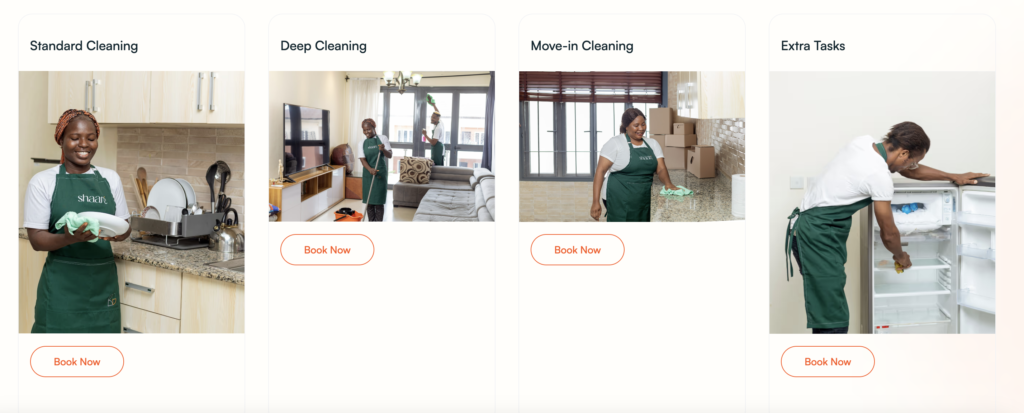
Shaaré’s workers are not hidden in the background. They are called Sparklers, a name that signals not only professionalism but also pride. This framing strengthens professional identity, which in turn drives higher motivation, improved service quality, greater retention, and a stronger sense of worker agency over time. As one Sparkler, Joy Gregory, said:
“My customers say I am hardworking and reliable.”
Consistent standards and reliability build household trust, turning occasional one-off bookings into repeat and routine demand, creating more predictable shifts and income stability for workers, as well as opportunities for growth. In the words of customer Adeleke, the Sparkler who works for him:
“Leaves the house truly refreshed and keeps improving her service every time.”
Over time, this consistency begins to rival or even outperform traditional, person-based domestic work relationships. Households are no longer directly managing an individual; they are able to leave trust, quality control, and continuous improvement to the platform. The reality is, this trust drives retention, stability, and eventually scale.
As a result, today Shaaré is seeing:
- Majority of bookings as recurring
- Significant retention and repeat use
- High Net Promoter Score (85+)
- Growth outside current operating zones
- Sparklers reporting more predictable earnings
- Households explicitly citing trust and consistency
Why we invested
We backed Shaaré because it exemplifies a thesis we hold: some of the most impactful jobtech companies in Africa will formalise existing, high-volume sectors rather than invent new ones.


Shaaré is focused on advancing dignified work for women, creating reliable household support for working families, leveraging a scalable model that can expand into adjacent services, and establishing a market where quality pays for itself over time.
Shaaré is explicit about avoiding the extractive elements of early gig models seen elsewhere. The commission structure is transparent and sustainable. Workers do not pay to access jobs. Safety and support are human-led, not solely managed by algorithms.
Shaaré is small enough to listen, and experienced enough with a founder who previously led SweepSouth Nigeria to build responsibly at scale. Awazi Angbalaga learned firsthand why the model worked in South Africa and why a direct copy-paste might struggle in Lagos.
In Lagos, the demand for reliable home services is enormous, and a pure gig marketplace cannot guarantee quality, safety, retention and dignity.