TL;DR
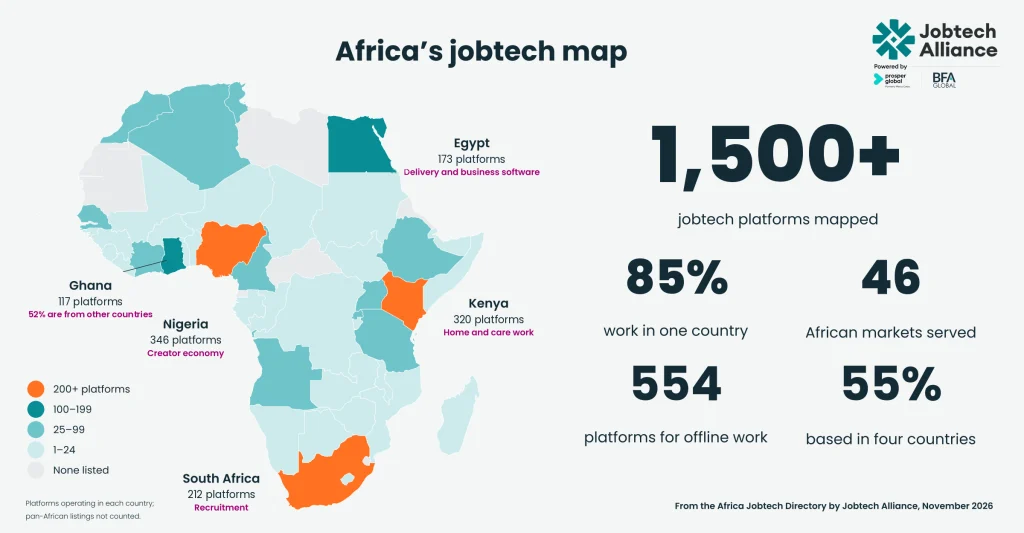
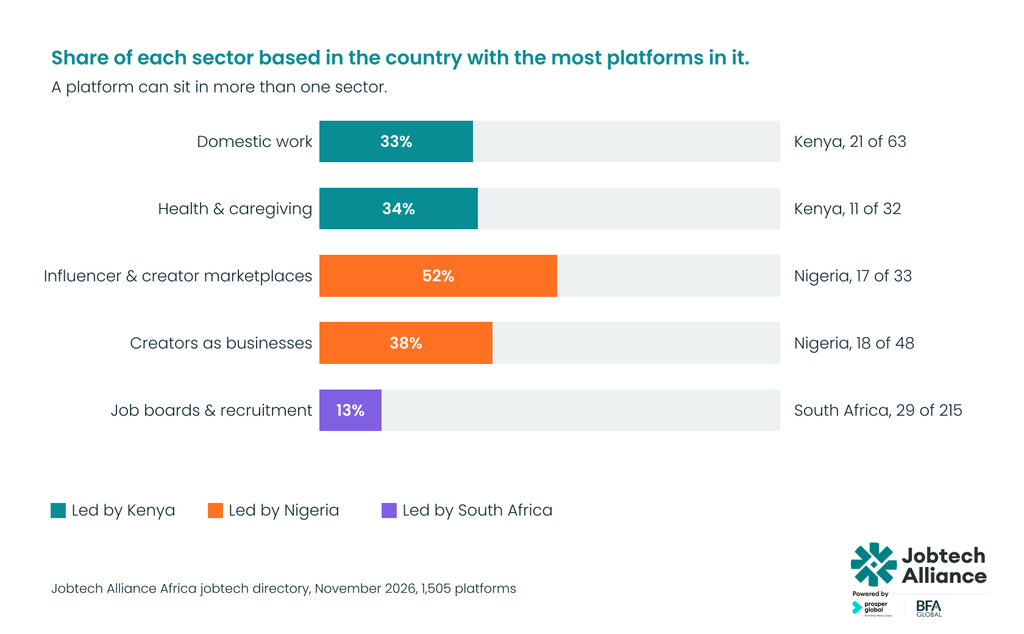
- 85% of the platforms we mapped operate in a single country. Each big market has its sectoral strengths: Kenya leads home and care work, Nigeria the creator economy, and South Africa leans towards recruitment.
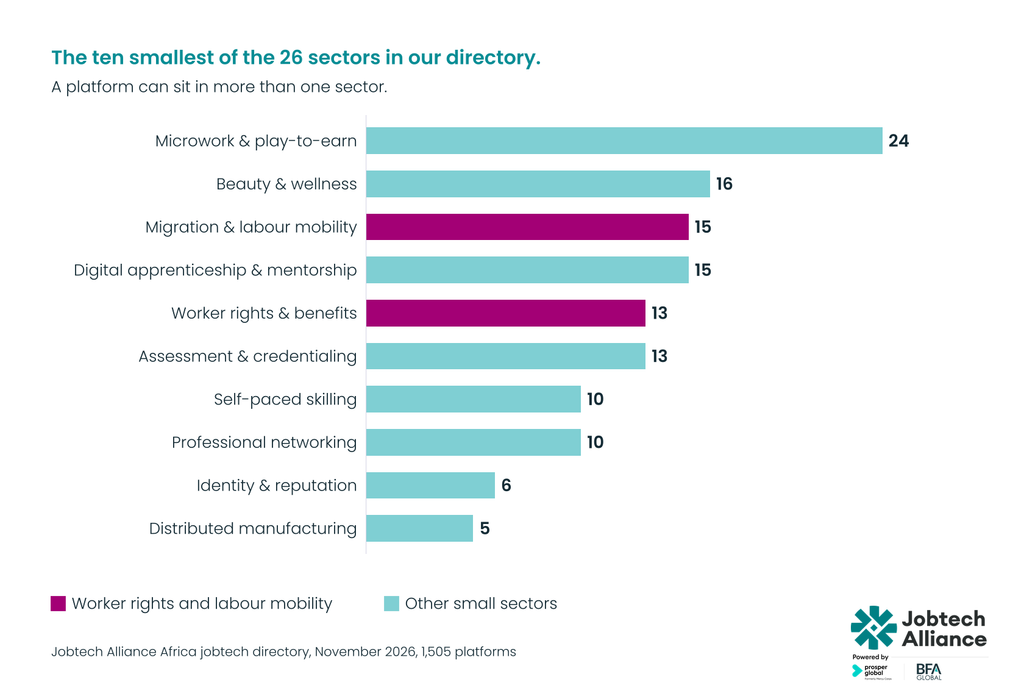
- The biggest group helps people find work they do in person (37%), followed by tools for small businesses (22%). Very few platforms are classified under worker rights and benefits, or migration and labour mobility.
You can search all 1,500+ platforms yourself, by country and sector, in our Africa Jobtech Directory. But first, we invite you to dig into our analysis.
What is jobtech?
Jobtech is bigger than its name suggests. Upwork connects freelancers with clients. Etsy helps craftspeople sell to customers around the world. Spotify pays musicians when their songs are streamed. None of them is usually described as jobtech, yet each one connects people to work and income.
Our definition of a jobtech platform is a digitally-enabled business or service that helps people find work, increase their income, or learn skills to earn more. The sector is diverse, impactful, and constantly changing. This is why we set out to map it.
Jobtech is hard to grasp in full because it is a layer that runs through ride-hailing, ecommerce, the creator economy, outsourcing and home services, so it rarely gets named, counted or funded as just one sector.
While the global players are household names, many of the smaller players, often African-led, are solving for the unique needs of African labour markets.
We all know Uber, but might be less familiar with the Kenyan-led equivalent, Wasili Cabs. We might know Patreon, but might be less familiar with those helping African creators earn, such as Selar in Nigeria and Twiva in Kenya. Many have heard of Teleperformance, the global outsourcing giant, but few know Ethiopia’s R&D Group, which analyses football matches for global sports clients.
Most platforms focus on a single market
85% (1,280) of all the 1,505 platforms operate in just one country. Another 11% (169) work in two or more named countries, and only 4% (56) are classified as pan-African. Of the 169 multi-country platforms, only 11 operate in ten or more named countries.
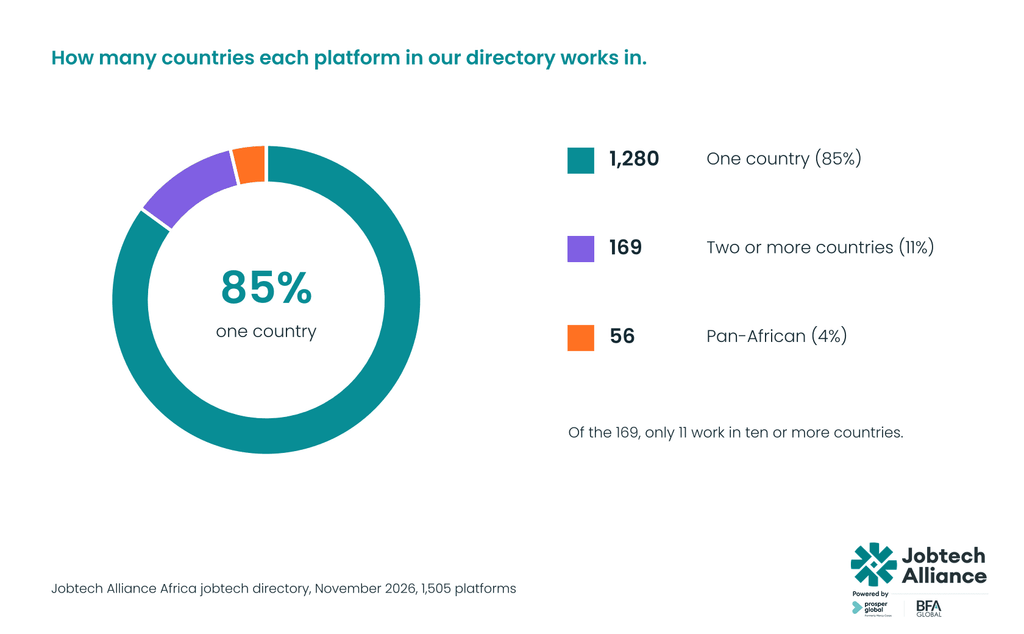
This is not surprising. As we’ve examined before, jobtech platforms in Africa are typically not just solving for the information gap between supply and demand, but doing training, quality control, supply chain, demand generation, and more. This means that we see more small single-market platforms than multi-market.
Also unsurprisingly, digital work scales across borders more easily. A quarter of freelancing platforms (27 of 106) and four in ten microwork platforms (10 of 24) work in more than one country.
The exception: in some countries, most platforms come from elsewhere
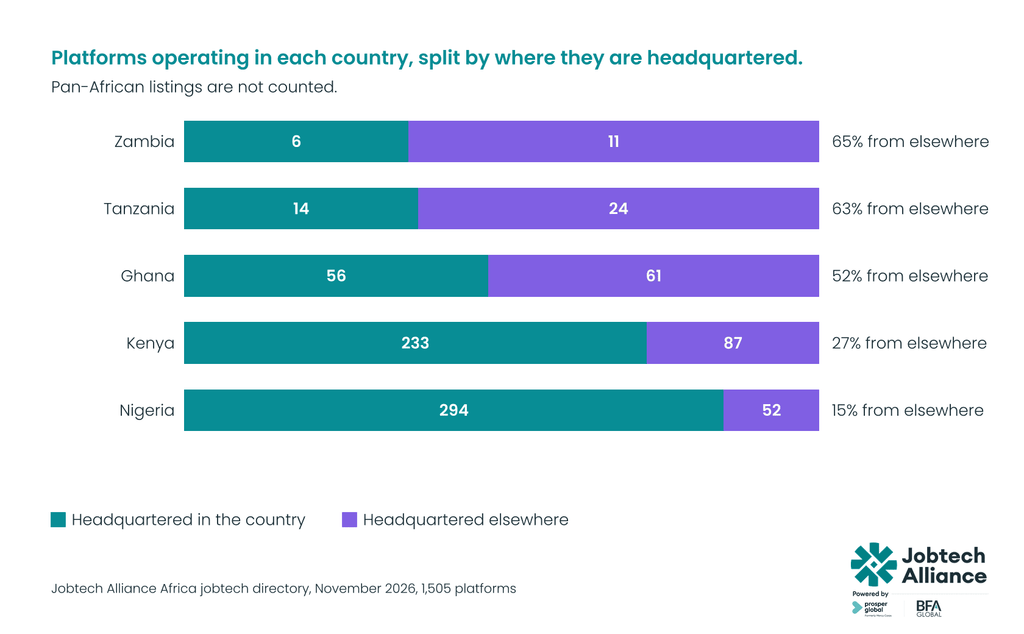
In a few smaller markets, the pattern flips. In Tanzania, 63% of the platforms operating in the country (24 of 38) are headquartered elsewhere. In Zambia it is 11 of 17, and in Ghana about half (61 of 117). In Nigeria, by contrast, more than eight in ten are homegrown.
Most of these outside platforms are African. In Tanzania, Zambia and Ghana, 43 of the 74 come from other African countries, led by Nigeria and Kenya.
Another 131 platforms are run from outside Africa, mainly the United States and the United Kingdom. Most offer digital work, like outsourcing and freelancing, which doesn’t need a large local presence.
Jobtech is more offline than you think
We classify platforms into five categories, and the biggest by some distance is platforms for offline work: 37% of all platforms (554), where the work is found online and done in person, such as a delivery, a plumbing job or childcare.
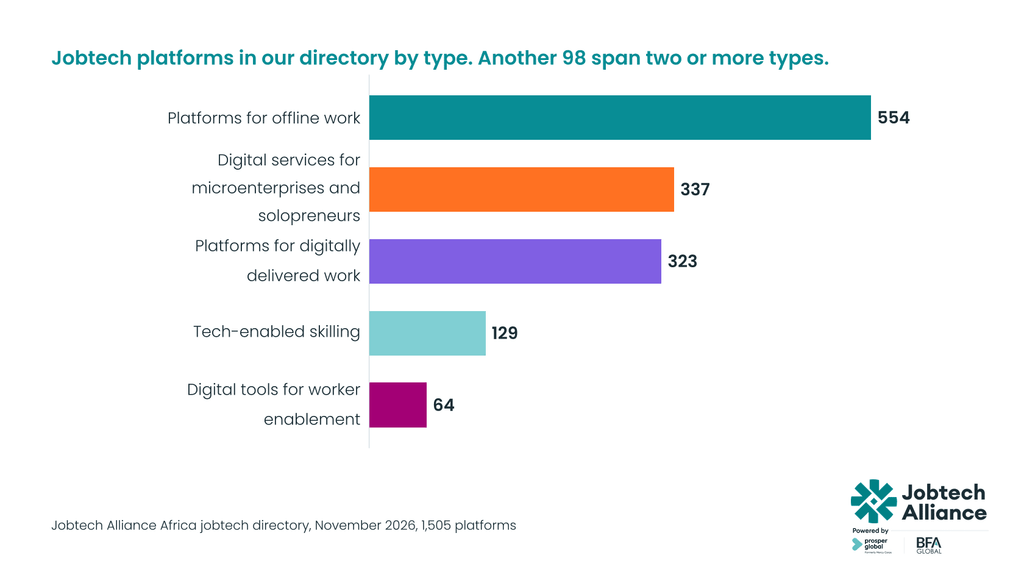
Digital services for microenterprises and solopreneurs come next at 22% (337). These are the tools that help a trader or a tailor sell more and keep the books; recognising that most ’employment’ in Africa is really self-employment, this should come as no surprise.
Platforms for digitally delivered work follow closely at 21% (323). Here the work itself happens online: outsourcing firms handling customer support, freelance marketplaces for designers and developers, and platforms where creators and influencers earn. Tech-enabled skilling adds 9% (129), and 98 platforms fall into two or more types.
Every big market leans towards a different sector
- Kenya leads home and care work. It is home to 47 of the 176 platforms in domestic work, health and caregiving, and blue collar trades, including 21 of the 63 domestic work platforms for nannies, cleaners and house managers. This is potentially driven by the combination of the country’s sizeable informal sector alongside its high levels of digitisation.
- Nigeria leads the directory’s creator economy listings. It hosts 34 of the 80 platforms that help creators and influencers earn, and it leads 14 of our 26 sectors outright.
- South Africa leans towards recruitment. Job boards and recruitment are its biggest sector, with 29 platforms including Pnet, CareerJunction and JOBJACK, driven by the fact that it has one of the largest formal employment sectors in Africa.
Few platforms focus on worker rights or labour mobility
Only 4% of platforms (64) are classified under Digital tools for worker enablement, and just 13 under Worker rights & benefits. Labour mobility is just as thin. Only 15 platforms appear under Migration & labour mobility, and more than half (8) are headquartered outside Africa, in Saudi Arabia, the United States, France and Germany.
What’s next
Explore the Africa Jobtech Directory. If you run a jobtech platform, join our community. And if we’ve missed a platform or got something wrong, let us know.
About the data: figures are as of November 2026.
The directory brings into view platforms that are contributing to the future of work but are rarely recognised for it. It will keep changing as more platforms launch, close and enter new markets. We’ll continue checking the listings and adding platforms that meet our criteria.