TL;DR: Nobody here came down a mountain clutching stone tablets. We’re not trying to preach, but five years and 600 platforms later, a handful of “truths” have refused to be disproven. Join the live conversation as we break them down.
1: A platform is not simply a platform
2: Platforms have to solve market failures
3: Platforms can truly create jobs
4: Platforms have to solve for demand
5: Platforms can be more inclusive than the “offline” world
6: Jobtech fits into a portfolio of work
7: Quality of work ≈ quantity of work
8: AI is making platform-based skilling work
9: Most platforms in Africa are small, but there’s value in that
10 (waiting to be proven wrong): Blue-collar gigmatching can’t scale
The Jobtech Alliance started from a belief that the technology that connects workers, customers and businesses (jobtech platforms) can build meaningful livelihoods for young people across Africa. But no one knew how that might happen. Which platforms are active? Where are they active? Who has been successful? What has worked? What hasn’t? Are workers happy?
No one had any data. No one had a bird’s-eye view. As a result, the ecosystem seemed stagnant, funders were not particularly interested, and jobtech platform founders were often treading on the same unproductive ground.
Since 2021, the Jobtech Alliance has gathered:
So what have we learned from all of this?
It can be hard to synthesise across such a big and diverse dataset, both quantitative and qualitative. A lot of the insights are time-bound. A successful platform one day can fail a year later. Today’s high-growth sector can plateau tomorrow. A rule that applies a hundred times can be stumped by a new data point. Many of our learnings are moment-in-time, prompting action by our community now. Those learnings are not expected to be true two years later.
But some learnings were further reinforced the more data points we collected. Having just concluded our Phase 1, which ran from July 2022 to June 2026, we want to share these fundamental lessons with all. Enter The Ten Commandments of Jobtech.
1: A platform is not simply a platform
Jobtech platforms are often wrongly assumed to be either jobmatching (digital jobs boards connecting candidates to vacancies), or gigmatching (mediating a fixed-price gig, like an Uber ride, between a customer and a service provider).
But the jobtech sector is incredibly diverse. It is better to think of it as “a technology layer” across many sectors and labour markets, rather than a specific type of model.
Assuming similarity risks overlooking what makes a particular model work or how different models can produce similar livelihood outcomes. The examples are many:
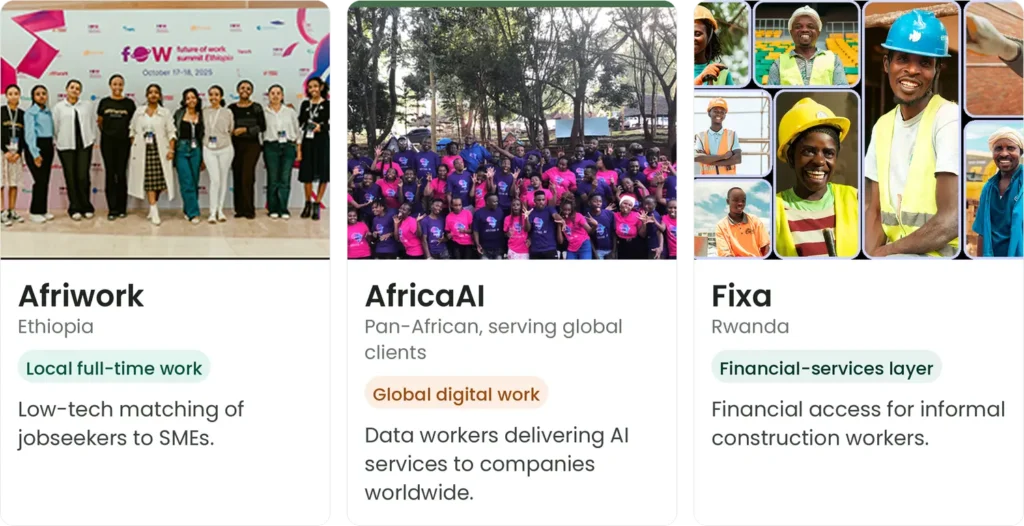
- A platform might be facilitating a full-time job, but there is huge diversity in how this gets done. Afriwork, for example, matches jobseekers to SMEs in the local market using a low-tech model in Ethiopia. Aedilo connects Kenyan blue-collar workers to roles in the Gulf states, relying on physical labour mobility, while AfricaAI manages data workers providing AI services to global companies, i.e. providing digital work.
- A platform might be facilitating a gig or short-term service, which could be fixed by the platform (like Uber) or variable/negotiated (like Fiverr). It could just facilitate the match, which we call a lead generation model, or oversee the entire service delivery and payment on the platform.
- Rather than facilitating labour, a jobtech platform might be facilitating the transaction of a product, often thought of as ‘e-commerce’. Even here, there is a lot of diversity: a platform might be taking care of logistics (or not), building for specific markets, just offering a digital storefront, or many other permutations.
- Many platforms actually see the service provider or merchant as the key customer, rather than the product/service buyer. With over 40 million microenterprises in Africa, there is huge potential in platforms which help them to manage their businesses better — reducing their costs, increasing their sales, and reducing leakages which increase take-home earnings.
- Some platforms are not focused on the transaction of labour and services itself, but seek to improve the livelihood outcomes of those already engaged on platforms or in the labour market. For example, Fixa in Rwanda improves access to financial services for informal workers in the construction sector.
A platform is not simply a platform, in the same way that an apple is not an orange. The viability and scalability of a platform, as well as its potential contribution to user livelihoods, lies in the subtleties of the model.
2: Platforms have to solve market failures
It is often assumed that jobtech platforms’ primary function is “matching”. In the US, that might be the case. If a customer finds a plumber on a US-based platform, that plumber already has accreditation, soft skills, tools, a van to get around, and access to the supply chain. There is already a functioning labour market, and the platform is just solving for information asymmetry by improving the information layer to help the customer efficiently find the right artisan.
In most of Africa, labour markets might not function particularly well. The plumber doesn’t necessarily have the latest technical skills, and the vocational qualification might not be a good demonstration of capacity. They might not have tools; they might pay disproportionately for buying parts as they only buy small quantities, and they will, almost certainly, be at the whim of traffic and a poorly connected bus system in cities like Kinshasa, Addis Ababa and Lagos.
It then becomes the role of the platform to solve these labour market failures: skilling (in technical or soft skills), connecting to supply chain, asset financing, quality control, payments, customer management, marketing.
In our first-ever blog, we wrote how a Kenyan blue-collar gig platform did this, but we see the same phenomenon from any platform that gains a meaningful customer base: they also have to solve for labour market failures.
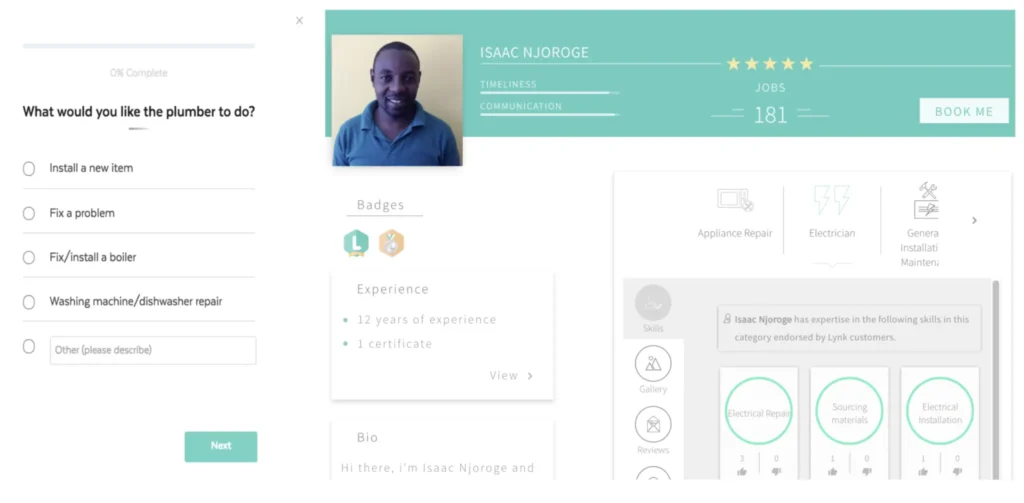
One direct implication of this commandment is that the role of tech in jobtech varies accordingly. Some platforms can be heavily product-led, utilising digital services to increase access to opportunities, but others can be heavily operational, focused on in-person training, quality control, or logistics. This reality is where what we call ”multiplayer mode” can thrive, shifting the burden from a single platform to a more coordinated ecosystem.
3: Platforms can truly create jobs
Job-matching platforms mostly reshuffle work that would have happened anyway. What makes the jobtech sector in Africa so exciting to us is how platforms can truly create jobs.
Take Selar in Nigeria. Africa has never lacked creators. Every day, people write courses, design templates, build tools and create digital products that others would happily pay for. But much of this work was never commercialised because it was too difficult to package, market and sell online.

Selar changed that. By making digital products easy to package, sell and distribute, it transformed creative work into products people could actually buy. It didn’t create Africa’s creators. It created a market for their work.
The platform economy has a remarkable ability to turn non-consumption of labour into consumption. African platforms do this in several ways: packaging labour so it’s more consumable, monetising under-monetised sectors (like Selar does), improving quality, opening access to global demand, or reducing cost.
This is the reason we love the potential of the jobtech sector in Africa. After all, “Africa’s ‘youth employment crisis’ is actually a ‘missing jobs crisis’.” Platforms offer much more to an economy than merely improving matching or building efficiencies; they can create new opportunities for Africa’s youth.
4: Platforms have to solve for demand
Africa does not suffer from a shortage of workers. It suffers from a shortage of paying customers. Adding a tech layer on top of a structural demand deficiency will not miraculously create demand for labour.
Yet most platform entrepreneurs, and most of the funding and programming around them, obsess over supply. They zoom in on recruiting users, building communities, training providers, onboarding merchants. In our experience, that is rarely the biggest challenge. We frame this supply-demand tension as a chicken-and-egg dilemma.
Once genuine, repeat demand exists, supply almost always appears. The best jobtech platforms therefore spend disproportionate effort understanding customers, obsessing over willingness to pay, customer acquisition, repeat purchase, unit economics, and why someone chooses their service instead of doing nothing at all.
This dynamic does shift as a platform matures, and supply quality still has to be solved. But founders and funders systematically over-invest in supply because it is visible, fundable, and emotionally compelling, while demand is slow and often unglamorous.
5: Platforms can be more inclusive than the “offline” world
Africa’s offline labour market rewards those with existing social capital and connections (typically older men) because work is so often allocated on the basis of who you know, sidelining young women, displaced, rural youth, refugees, and people with disabilities.
Jobtech platforms can offer opportunities to these groups that wouldn’t exist otherwise. For example, 70-80% of women say platform work generates income that doesn’t exist offline.
Platforms can achieve this in many ways. They overcome access barriers by matching people on merit rather than networks, by offering near-zero-capital entrepreneurship models (like Tendo does in Ghana), and by overcoming geographic poverty and the ability to work beyond immediate locality (like Hugo does for Nigeria). Platforms can also offer flexible work suited to the unpaid care load women disproportionately carry (~2.7× that of men in sub-Saharan Africa).
Our gender- and age-disaggregated earning data collected from over 50 platforms, over three years and 250k users, shows that, when given the chance, women outperform men across jobtech platforms. 78% of women platform users cite control over their hours as a key draw, and displaced individuals value digital work for overcoming mobility barriers. For refugees, platforms provide the infrastructure to find work despite missing local ties and, often, a legal right to work.
6: Jobtech fits into a portfolio of work
Youth employment in Africa is not binary. Very few people are either “employed” or “unemployed”. Most are piecing together income streams from formal and informal employment, self-employment, agriculture, and/or family business; otherwise known as a “portfolio of work”.
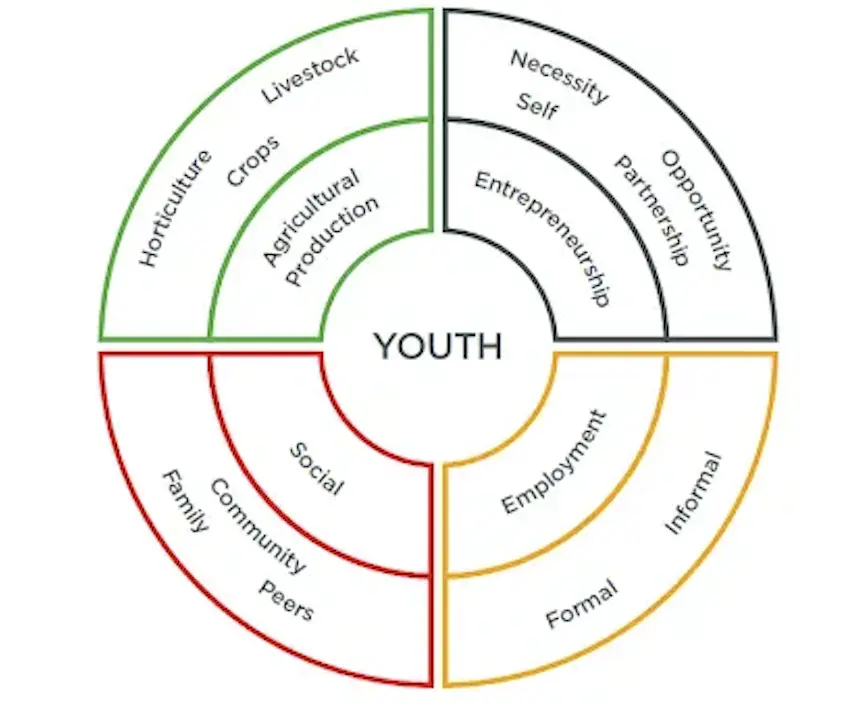
Source: Mastercard Foundation
It should therefore come as no surprise that earnings from jobtech contribute to this portfolio in different ways. From our Quality of Work survey with a sample size of only two platforms, we found that 79% of those earning from the platform earned less than half of their income from that specific platform. Users might be earning small amounts from a single platform related to their existing field of work, might be “multi-homing” (think of a ride-hailing driver simultaneously on Uber/Bolt/InDrive/Yego), or might be earning small amounts from multiple platforms.
This recognition is critical to understanding if/how platforms are offering quality work. A platform that requires being online for 12 hours is functionally full-time work and must be benchmarked against full-time salaries, but a platform like Wowzi, for example, offers individual ‘nano-influencing’ gigs that can be done in spare time in the evening alongside other livelihoods.
Check out this fun video to learn more about digitally-mediated portfolios of work:
7: Quality of work ≈ quantity of work
Together with the International Labour Organisation (ILO), the Challenge Fund for Youth Employment, 60 Decibels, and others, we built a tool to measure a platform’s quality of work from the user’s point of view. The pilot was small, but the findings matched what users on just about every platform tell us:
Satisfaction with a platform correlates almost entirely with how much work they get from it. Quality of work, in users’ eyes, is mostly quantity of work.
There is probably a bell curve at the far end. Someone earning 80%+ of their income from a single platform is exposed to every change in T&Cs, and frustration follows. Our pilot doesn’t show this yet, but we’ll keep looking as the research expands.
If quantity is what users feel, quantity is what platforms should count. This is where the numbers deserve proper interrogation. Our definition of a quality job covers size and regularity of income, target user, and contribution to livelihood. We have been tracking quality jobs since the first platform reported data, and, as illustrated below, the stat has refused to move.
Whatever the sector, whatever the model, roughly one in four users who earn a dollar go on to earn a regular, meaningful income, with a recent upwards trend.
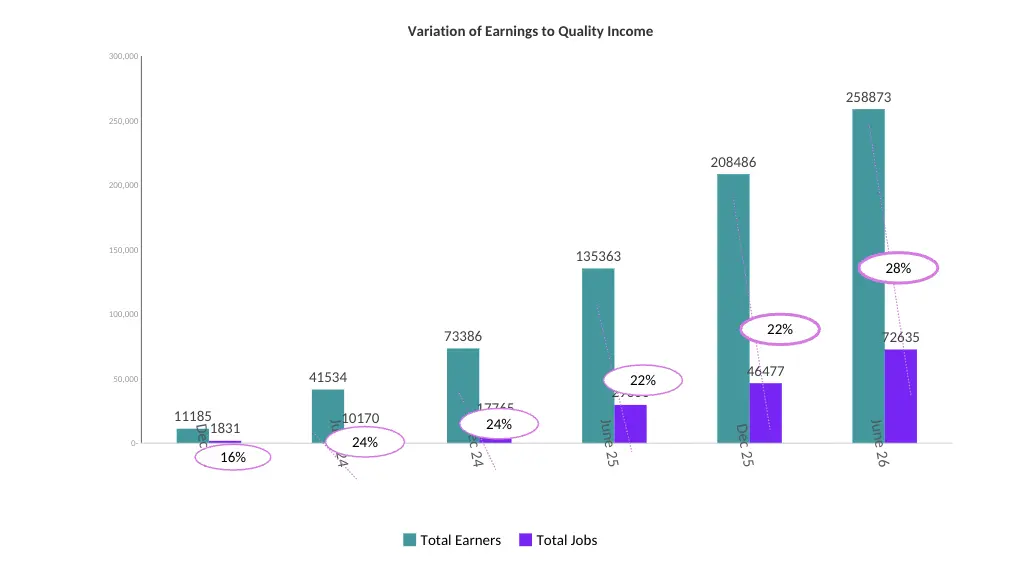
The other three quarters also matter. Our research on these ”microearners” found some were irregular by choice and most wanted more work, but even small, sporadic income matters, especially when it is part of a portfolio of work.
8: AI is making platform-based skilling work
Jobtech platforms are, in theory, the ideal place to learn for the world of work. Skilling only sticks when it can be applied immediately to a real situation, which is why apprenticeships work but standalone training apps rarely do. Learning inside a platform that’s already delivering work is real-time, profile-matched, and instantly deployable, rather than happening in a vacuum. But that potential was seldom realised in the jobtech space: customising content for each business or user was punishingly expensive, and the business models rarely worked.
AI is newly offering this opportunity. It collapses the cost of customisation, auto-generating tailored content and simulations from a few simple documents rather than requiring bespoke builds for every business, sector, and product. It removes language barriers and adds accessible interfaces such as voice. It also unlocks viable business models, from companies paying for measurable performance gains to jobseekers paying small sums for coaching tied to an immediate, specific need.
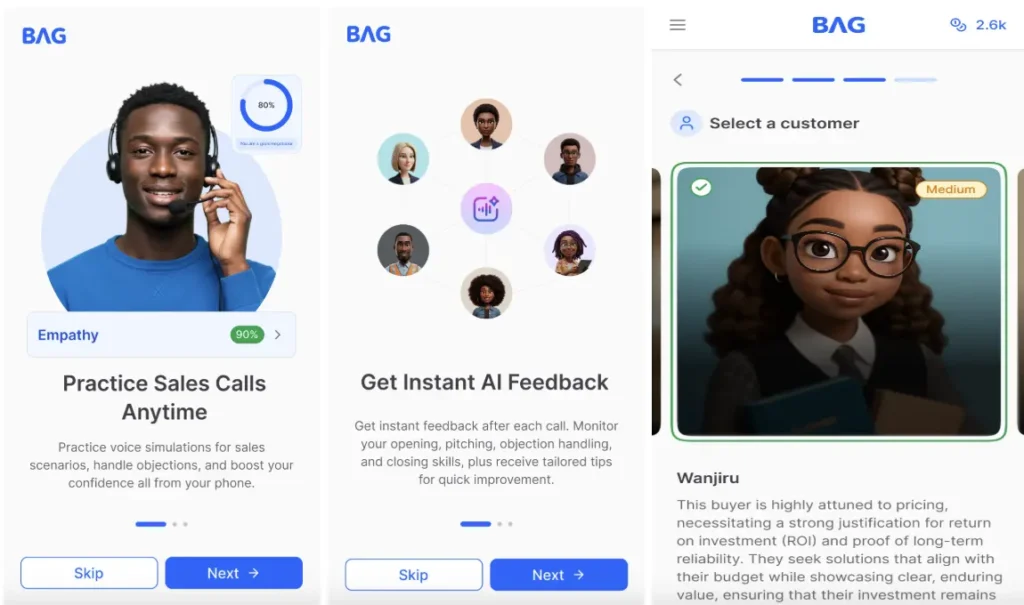
BAG’s AI sales coach, for example, lets users rehearse a live cold call with instant feedback before ever facing a real client, which can then feed directly into recruitment plans. Learn.ink lets clients upload a document or even a voice note and auto-generate a complete interactive module. A last-mile agent can now learn a new product in the morning and sell it at a kiosk that afternoon.
9: Most platforms in Africa are small, but there’s value in that
A successful platform doesn’t necessarily need 100,000 users. Take a plumber in Nairobi doing at-home services: with travel time, 2 gigs a day x 6 days a week = ~50 gigs a month. So 100 plumbers can perform 5,000 gigs a month, or 60,000 a year. And there are only so many leaky toilets in a city of ~300,000 middle-class households.
This is why “platform” and “hyperscale” don’t necessarily belong in the same sentence: investors should rightfully interrogate claims of millions of users, and entrepreneurs often achieve far more by serving a smaller group and providing meaningful livelihoods for them.
Most jobtech platforms in Africa are small by definition. In the US, a platform solving for information asymmetry typically takes a horizontal approach, working on thin margins across many sectors or trades. Across Africa, when solving various contexts’ labour market failures, we see platforms typically building for deeper verticals, often targeting niche or high-end customers that have the ability to pay. This is experienced at its most extreme in the more challenging labour markets (see Commandment 10).
Globally, there is a strong narrative around extractive monopoly platforms dictating terms and abusing the rights of users. But the vast majority of platforms in the African jobtech community are functionally SMEs, trying to solve for deep labour market failures.
The strongest platforms we have seen go vertical first, then once operating at some scale, start to horizontal out sector by sector. If we’re looking for scale, this means recognising where single platforms might not be the solution, and approaching the space with an ecosystem lens rather than expecting to solve labour market failures through one specific platform only.
10 (waiting to be proven wrong): Blue-collar gig matching can’t scale
There are always exceptions to the lessons we’ve learned. For example, we thought that job-matching platforms didn’t really work in Africa given the small formal sector and limited willingness to pay for the service, but Afriwork in Ethiopia stumped us with their scaled Telegram-based model targeted at SMEs. The Afriwork exception comes from a combination of a product well-designed for the local market and the market’s idiosyncrasies. Ethiopia is going through its first wave of digitisation, where solving for information asymmetry is a big step in itself.
We had been hoping to find an exception to the rule that “blue-collar gig matching doesn’t scale”. We’ve found some amazing platforms fixing deeply broken labour markets in the blue-collar space (see our experiences from working with GoodayOn in Ethiopia), but we haven’t seen models reaching scale, despite creative commercial and operational innovations.
The economics are brutal. Blue-collar gigs are infrequent and low-value, so a platform earns a thin commission, but to make that one match work it has to carry the full cost of vetting, skilling, quality control and dispute resolution (see Commandment 2), and then potentially watch the customer go off-platform. The one exception could be Fixa, but it is focused on an HRtech approach rather than simple gig matching. We continue to wait for a true exception.
We end with Commandment 10 as a challenge, as all of these are challenges to solution finders and entrepreneurs seeking to build meaningful livelihoods through jobtech platforms in Africa. These ten commandments are only the start. They have proven to be true from the bird’s-eye view that we’ve been lucky to hold over the last half-decade. But the whole point of having such a fantastic vantage point is to keep looking and learning. Join our community.
Watch the session where ten jobtech veterans, including our steering committee, shared their take on each of the commandments above.