Co-authored by the Refugee Investment Network (RIN), Acumen, and Jobtech Alliance
Across East Africa and beyond, refugee response is undergoing a profound transformation. The entire asylum and traditional funding model is shifting. Now more than ever, in order to respond, we need to move beyond humanitarian aid toward investment-driven models of self-reliance and job creation.
Governments, development banks, and private investors are increasingly recognising refugees not only as beneficiaries of aid but as economic actors with the potential to contribute to local growth and resilience. For example, the economic inclusion dividend of refugees in Ethiopia, as calculated by the World Bank, found that full integration could save the government $143 million annually for at least one million refugees.
Refocusing financing
Major initiatives and financing mechanisms are channeling capital into enterprises and programmes that unlock the economic potential of displaced populations, strengthen host economies, and promote social cohesion. These can include:
- Results-based financing: Programmes like the World Bank and Government of Kenya’s Outcome Fund for Employment of Refugees (OFFER) prioritise measurable outcomes such as jobs created or businesses launched. Investors and implementers are rewarded when displaced people gain meaningful employment, aligning incentives for both social and financial performance. Blended finance also allows for impact-linked instruments, where investors’ returns increase when projects meet specific inclusion or sustainability metrics: such as gender balance, refugee employment, or environmental resilience.
- Blended funds and risk-sharing facilities: Partnerships such as the IFC-Equity Bank $20 million risk-sharing facility in Kenya use guarantees and co-investments to extend credit to refugee and host community enterprises. This de-risks lending, expands access to capital, and helps build long-term financial inclusion.
- Layered capital structures: Many refugee-lens investment funds employ a “layered” capital approach, with first-loss tranches from donors or foundations absorbing early risk, thereby allowing development finance institutions (DFIs) to contribute. For example, the AlphaMundi-IRC Shared Pathways Fund, which is currently under design, channels capital into early-stage refugee-inclusive SMEs that would otherwise be overlooked.
Meanwhile, governments are increasingly embedding refugee inclusion in national economic policies. In East Africa, for example, Kenya’s 2025 Shirika Plan integrates refugees into public services, financial systems, and local economies. Ethiopia’s 2019 Refugee Proclamation grants refugees the right to work, own businesses, and engage in self-employment. Uganda guarantees refugees the right to work, move freely, and access education and healthcare, while channeling aid into host communities. It also has the Country Refugee Response Plan is one of the few countries that provides refugee households with plots of land.
Showcasing refugee-led and inclusive enterprises
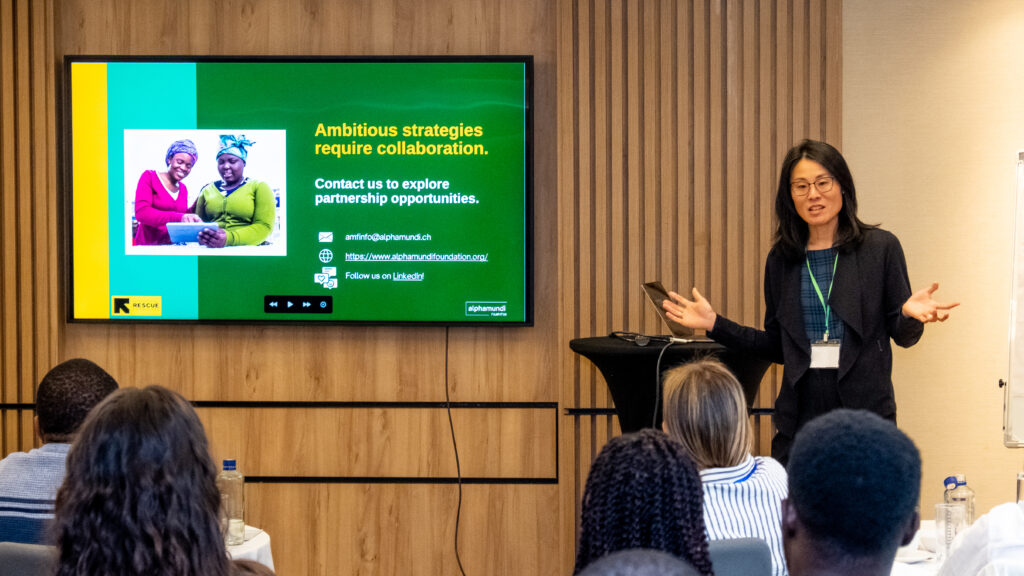
In September, the Refugee Investment Network (RIN), in partnership with Acumen and Jobtech Alliance, convened the Refugee Lens Investing (RLI) Roundtable: “Jobs and Journeys” in Nairobi. We brought together over 40 investors, entrepreneurs, and ecosystem leaders exploring how innovative financing, technology, and entrepreneurship can create dignified work opportunities for displaced people and their host communities across East Africa.
The roundtable showcased a new wave of enterprises, including Ezy Agric, Ecoplastile, Resilient People, and AfriFarmers. These businesses exemplify how applying a refugee lens to investing principles can simultaneously achieve impact and profitability. These are business models that generate employment, bolster value chains, and broaden access to services within communities affected by displacement.
Each business involves refugees and host communities as employees and/or suppliers. They also use technology to cultivate inclusive markets, ranging from the digitisation of smallholder value chains to the conversion of plastic waste into durable construction materials. actively involving refugees and host communities as both employees and suppliers.
What makes a difference
We walked away from the roundtable with three key takeaways:
- Blended finance is the way forward
Blended finance combines humanitarian and development funding with private capital to de-risk investments, making it more attractive for commercial investors to support businesses in refugee and host communities. Through it:
- Public capital can leverage private investment.
- Social enterprises can secure growth funding and incentives for inclusive business models.
- Investors achieve both financial returns and demonstrable social impact.
- Patient capital helps validate business cases and models
Companies that are exploring refugee or forcibly displaced persons (FDP) inclusion find that to create a sustainable model with this population, greater patience, subsidy and incentives are needed. These help buy down the risk of servicing populations which are generally further away, and have less access to finance and land.
Roundtable participants agreed that patient capital is essential in this context.
This type of funding allows companies the necessary time and flexibility to validate their initial hypotheses and refine their business models in the often complex and volatile environments where refugee communities reside.
After these initial proof-of-concept phases, demonstrating both viability and impact, companies can scale up their operations, and continue to include and grow their support for a broader population of refugees.
For example, Acumen’s Forcibly Displaced People Lens Investment Initiative in the Horn of Africa, supported by Conrad N. HIlton Foundation, IKEA Foundation and the Swiss Agency for Development and Cooperation (SDC) utilises patient capital in the form of equity, convertibles, impact linked technical assistance, grants and prizes.
- Collaboration drives scale
As East Africa continues to lead innovation in linking jobs, technology, and displacement, the growing ecosystem of investors and entrepreneurs shows that inclusive markets are not a distant reality. They are investable, scalable, and essential to the region’s economic future.
But innovative, blended financing mechanisms require collaboration beyond funding. Sustained and sustainable outcomes need policy support from governments, and more active collaboration with displaced communities themselves.