By Janet Wandia and Margarita Dimova
TL;DR We know inclusion doesn’t just happen. It’s about how intentional jobtech platforms are. With our inclusivity framework, we want to help platforms in Africa to self-diagnose and improve outcomes for (young) women, refugees and people with disabilities, among others.
Inclusivity is at the heart of the Jobtech Alliance’s mission! That is why we are now laying the groundwork for a deeper dive: a groundbreaking inclusivity framework for founders. We have piloted it with 12 platforms, and we are seeing founders already making adjustments to their strategy and operations based on it. As one founder of a fast-growing jobtech platform shared a moment of honest reflection:
“We thought we were inclusive. We had women on the team, we ran campaigns with smiling women users. But when we looked at the results, we realised we had no idea how women were actually doing on our platform.”
This realisation is far from unique, in our experience.
Good intentions don’t translate as positive outcomes for underserved populations
Across Africa’s jobtech landscape, platforms are waking up to a hard truth: good intentions don’t always translate into good outcomes for the underserved. Many founders want to build inclusive platforms. They believe in the power of jobtech to unlock opportunities for underserved communities, but when it comes to designing intentionally, tracking results, and implementing truly inclusive strategies, many don’t really know how to put it into practice.
This is where we come in. Based on 3+ years’ of providing venture building support, and collecting (disaggregated!) quantitative and qualitative data on user outcomes and experiences, we built the Jobtech Inclusivity Framework.
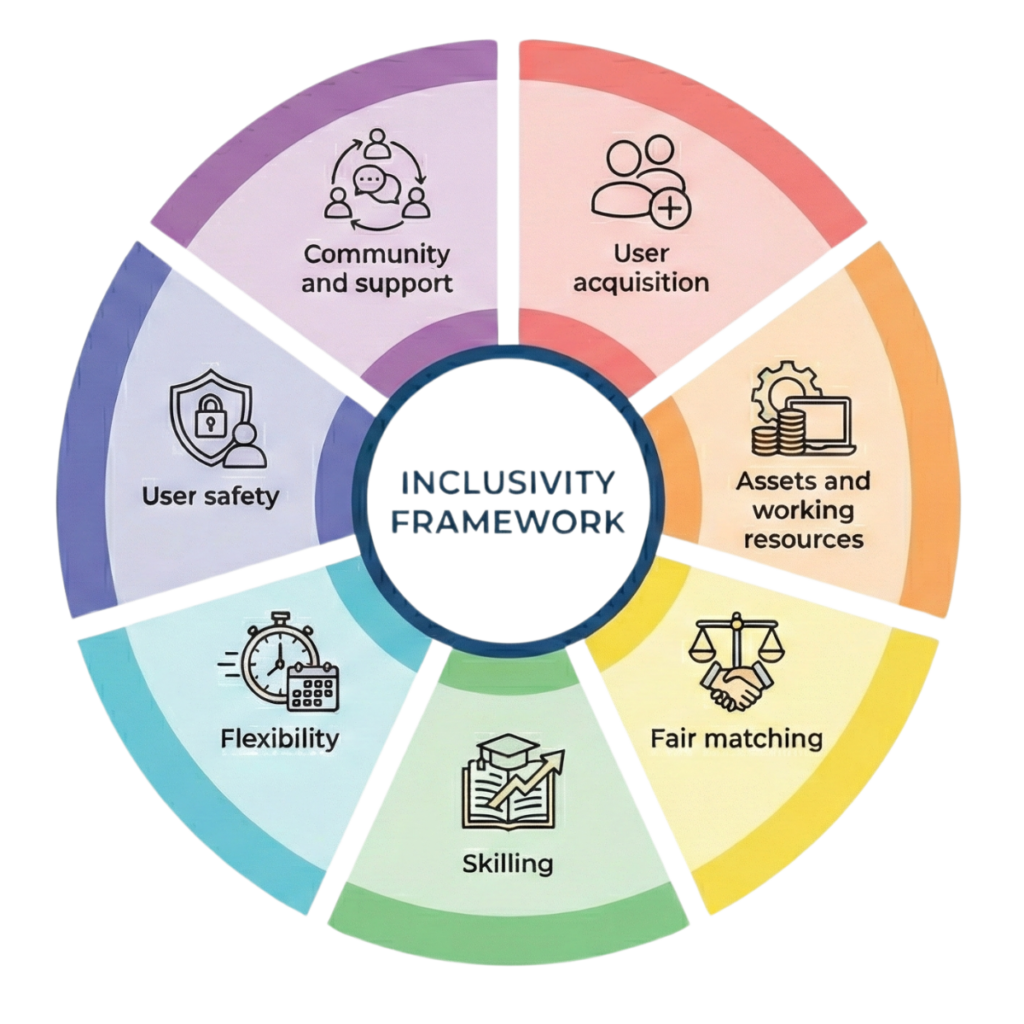
The framework is designed to help jobtech platforms, investors, and other ecosystem actors better understand and support the participation and performance of underserved populations. We have a particular interest in young women and refugees, but our framework can easily be adapted to other underserved populations.
Using our inclusivity framework as a diagnostic tool
Our framework offers a structured way to assess inclusivity across seven dimensions, helping identify operational gaps, design more inclusive interventions, and inform funding or policy decisions. We are focusing on the most powerful levers of inclusion that are still underutilised, as our work in the sector continues to demonstrate. Ultimately, based on the learnings from using this as a scoring tool, our goal is to build a playbook of proven strategies that increase engagement and earnings for underserved users on jobtech platforms.
While there are similar global tools for inclusivity in entrepreneurship or employment, few are tailored to Africa’s jobtech ecosystem, and fewer still are built with input from platform users and operators themselves. Our framework fills that gap because it is:
- User-centric: grounded in sex- and age-disaggregated data (SADD) and other complementary data, including qualitative data that covers performance metrics and allows for continual measurement of success.
- Sector-specific: reflecting on the realities of the jobtech sector.
- Applicable and actionable: it doesn’t just diagnose, but it helps founders find the right interventions, from low-lift tweaks to high-impact redesigns.
- Accessible: simple enough for founders and teams to use independently, encouraging ownership and continuous improvement.
What’s next
We are deploying the inclusivity framework at the start of every one of our venture support engagements to identify where we can support platforms to improve inclusivity of underserved populations. We will continue reviewing the framework based on what we learn from implementation.
This is just the beginning. Our aim is to see the founders and operators use the scorecard to systematically assess, track, and improve how their platforms advance their users’ engagement and performance on jobtech platforms. We would like to have the framework act as a bridge to two worlds – inclusivity and platform growth – by evidencing that inclusion isn’t just a social good, but good business.
Beyond platforms themselves, ecosystem support organisations, development actors, development partners and donors, investors, researchers and policy-makers can also deploy this tool, in line with their commitments to making jobtech viable, scalable, dignified and impactful for all.
We will be hosting a series of masterclasses to unpack the framework. More details on this to follow in the coming weeks.