My son, Callum, is almost exactly a year older than the Jobtech Alliance.
I’ve been talking about him regularly in these annual navel gazing reflections, as his personal development milestones almost perfectly predict for me what is going to happen over the next year in the jobtech sector in Africa; year 1 was ‘The Year of Shouting’, year 2 was ‘Walking, Running, Jumping’, year 3 was ‘The Year of Exploring Independence’. Tellingly, it seems I never wrote one in year 4, the year his brother was born.

Above: The year of being forgotten
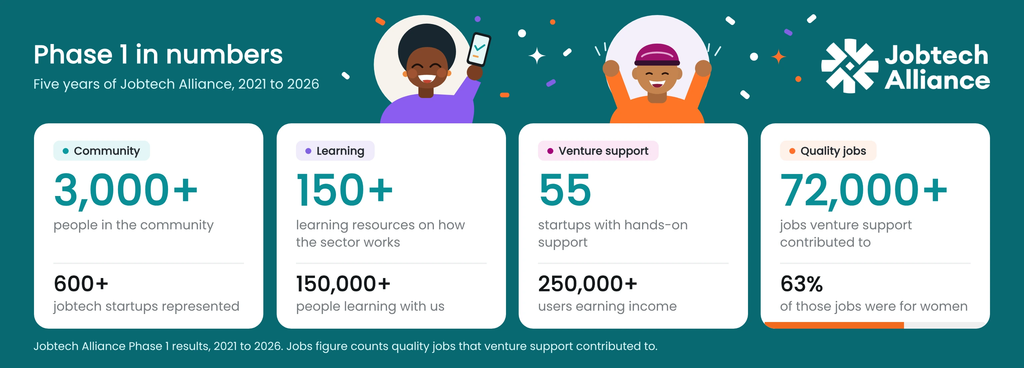
Last month, the Jobtech Alliance turned 5. A big birthday, and a marking of the end of the Jobtech Alliance’s Phase 1. In this first phase, we built a community of more than 3,000 key stakeholders, including operators in more than 600 jobtech startups working in Africa. We produced over 150 learning products about how the sector works and its impact on youth livelihoods that have been consumed by more than 150,000 people. We’ve supported 55 jobtech startups with hands-on venture support, who are reaching more than a quarter of a million users with real cash in their pockets. Of those, our venture support has contributed to more than 72,000 quality jobs, 63% of which were for women.
However, as we always say, the Jobtech Alliance is not ‘the jobtech ecosystem’.
And we’d be kidding ourselves if we said that ‘the ecosystem was built’.
What does ‘a built ecosystem’ look like though? At the Jobtech Alliance, we see five areas that we’re hoping to see the ecosystem evolve; we believe that these are the key ingredients to ensuring that the jobtech sector in Africa delivers upon our objectives of more jobs, better quality jobs, and more inclusive jobs.
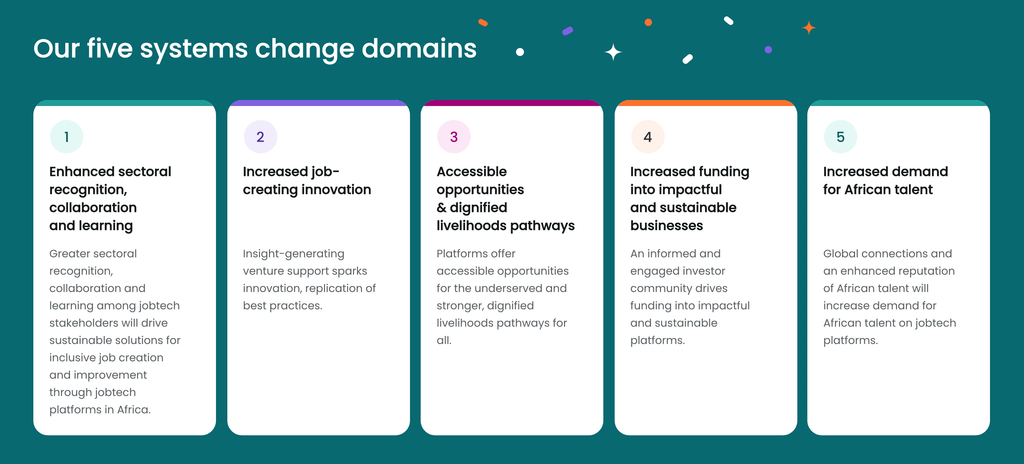
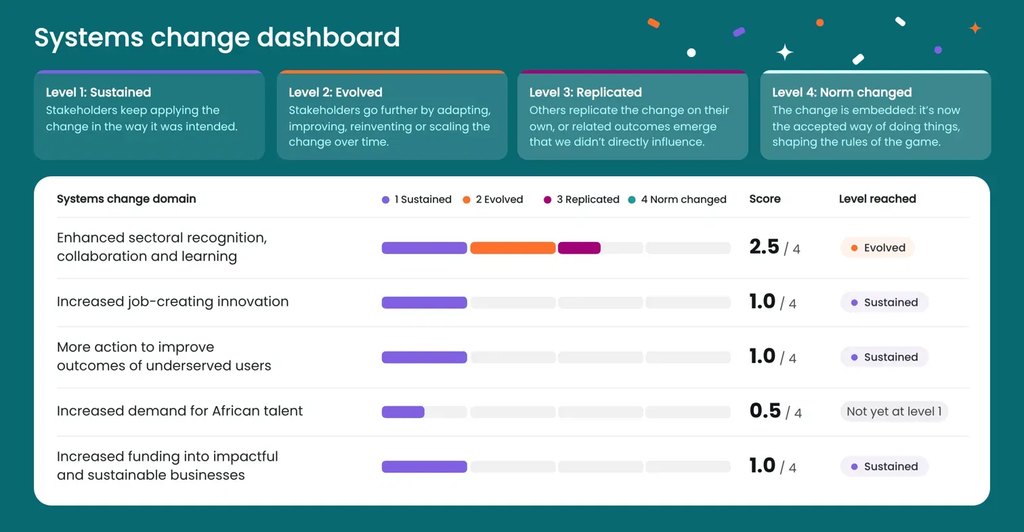
Using our direct engagements with hundreds of ecosystem stakeholders on a monthly basis, and some great sector monitoring from our newest team member, Claude, we observe what’s happening in these domains every month, and score the sector every quarter on a four-point metric (an adapted version of ‘Adopt, Adapt, Expand, Respond’, for nerds). Last quarter, this was the score:
There’s still rather a lot to be done.
The Jobtech Alliance’s mission continues to be a decade-plus-long initiative; you can’t build an ecosystem or change the way that labour markets interact with technology in just a 3-5 year project horizon. Phase 1 intended to launch an ecosystem, to make people care about how jobtech platforms will play a critical role in the future of work in Africa, and to work out how to make these platforms more impactful; more jobs, better quality jobs, and more inclusive jobs. Phase 2, which we’ve just started and which will run to ~2031, was always intended to be our scale phase, growing the ecosystem in new markets, replicating what works, and building deeper country-level momentum around changes in the system. Phase 3, our move to more sustainable models, will involve handing over our responsibilities where we can and moving our venture support model into a fund.
So where do we stand here at the end of 2026? As our systems change scoring above suggests, we are seeing encouraging signs around learning, sharing, and sectoral recognition. But other areas are taking more time. What ecosystem shifts have we seen over the last year, and what can we expect over the next year?
With African economies stumbling, global economies confused, and AI offering a hundred different possible futures, it is hard to predict what will happen next.
Well, it would be, if it wasn’t for bellwether Callum. What does it mean to be 5? Here are some typical milestones of a five-year-old, and what it means for this sector that we love:
Starting school and learning facts
When Callum started school, he was so excited to discover the ‘facts’. There were things that were true, and things that were not. While Callum’s facts are mostly about dinosaurs and space, over the last year we’ve seen an increasingly persuasive knowledge base consolidating around what works and doesn’t in the platform economy in Africa. We have clearer visibility of what’s going on in the sector; indeed you can search 1,500+ jobtech platforms operating in Africa in our Africa Jobtech Directory. Our 10 Commandments of Jobtech in Africa outline just some of the truths that become truer the more data we find. This increasing evidence base provides the sector with guidance on where to direct attention and resourcing.
Some of those facts ain’t pretty. Uber’s recent departure from Nigeria and Uganda reminded us just how hard this sector is in Africa, and left us with some open questions. Was this just a reminder of what we knew – that African jobtech needs to be built for Africa – or a sign of a race to the bottom that permeates African labour markets?
What is clear is that jobtech platforms in Africa touch every labour market sector, and solve deep labour market failures both by solving for supply-side failures (skills, accreditation, assets) and creating jobs on the demand side. But these deep solutions also mean that these platforms are often structurally smaller; we’re more likely to create a million jobs in Africa with a thousand platforms each offering a thousand jobs, than a single TaskRabbit copycat delivering a million. Moreover, we need to be realistic that these platforms rarely offer full-time jobs, but rather fit into young Africans’ portfolios of work.
Taking turns playing with others, and helping brothers and sisters
I’ve now got a second kid, Jesse. He’s a chill kid. But also, I’m a more chill dad. For your first kid, you worry, you don’t know if you’re doing it right. For your second kid, based on all you learned in Round 1, you know roughly what’s coming and you relax; you even start enjoying yourself. Callum is also helping, teaching Jesse the ropes himself, rather than all learning needing to come from his parents.
The goal of a thriving ecosystem is that older ‘brothers and sisters’ teach the next generation of startups about how sectors work; either through direct support and coaching, or through demonstration of what works and doesn’t – they signal market opportunities, drive replication, and warn others where not to go.
We always say that a thriving ecosystem doesn’t have a formal communication channel – it kinda happens through osmosis; enough people know the fundamentals, and enough people are well enough connected, that people ‘just know’.

Above: Actually not osmosis at all, but there’s probably an analogy here
Over the last year, we’ve increasingly seen best practices starting to be replicated, and some of the worst ones starting to be let go. Just a few examples of information moving more fluidly, and greater action based on this learning, include the following:
- Creator platforms increasingly orienting around treating creators as businesses; when we first noted the opportunity for platforms to treat creators as small businesses, we only saw one platform – Selar – building for this. A few years later, and we’ve seen replication across the continent, with platforms like Twiva offering a suite of services enabling creators to treat their trade as a real livelihood.
- Connected to the above, it was back in 2022 that we suggested that one of the greatest opportunities for platforms in Africa was building ‘vertical’ platforms for different microenterprise sectors. We’re starting to see that happening in depth. African unicorn, Moniepoint, recently acquired Jobtech Alliance portfolio platform, Orda, which builds digital rails to help small restaurants run better. Even more interestingly, we’re seeing South African fintech behemoth, Yoco, launching ‘microenterprise operating systems’, around retail, beauty, and food and beverage. Watch this space in 2027.
- Labour mobility is heating up. When we launched the Jobtech Labour Mobility Sector Scan last year, it felt like a very empty space. Driven by our ongoing commitment to always collaborate with others, we ran our first Cross-Border Jobs Startup Competition to create buzz around the space in collaboration with Labour Mobility Partnerships (LaMP), the International Organization for Migration (IOM), Dan Yu, now of the Africa Jobs Fund, and Tech Safari. Just a year later, and the space is much much busier. Dan Yu launched the Africa Jobs Fund, which is seeding private sector placement agencies in the labour mobility space, and LaMP replicated the cross-border jobs competition model in South and Southeast Asia with a range of new partners. Even the World Bank hosted a webinar on the topic.
- We’re also seeing a bunch of the smaller lessons from the sector being replicated. Ethiopian blue collar gig-matching platform GoodayOn copied the playbook of Lynk’s early success, and it’s paying off for them; they’ve just pivoted to 100% replicate this model.
Realising other people think differently
Somewhere around five, children work out that other people have thoughts of their own. Callum has discovered that Jesse doesn’t always want to play his game. To be fair, I’ve also realised that Callum sometimes doesn’t want to play my game.

Above: ‘I know the feeling bruv’
The Jobtech Alliance was birthed out of a recognition that not everyone was ‘playing our game’. Everyone thought that technology was going to play a critical role in the future of work in Africa, but no-one was aligned around what that really meant, and how to make it better. Indeed, the ecosystem around jobtech continues to oscillate between desperate efforts to drive digitization, an unrelenting ability of the philanthropic community to spend billions of dollars on unproductive training, and an uncertainty from governments around whether the sector should be more regulated or less regulated.
Disagreement is healthy, as long as those conversations can be directly had. In the last year, we saw maybe the biggest coming together of different visions for the jobtech sector, when the ILO adopted Convention No. 193, the world’s first binding international labour standard for the platform economy. The Convention offered a suitable balance between protecting workers and not over-regulating a job-creating industry. Most encouragingly for us, it involved a genuine coming together and debate between different sides of the equation, rather than conversations happening in silos.
The tooth fairy comes for the first time
Callum lost his first tooth a few months ago and still looks like a proper pirate. While I was shocked about the tooth fairy’s going rate for a tooth in 2026, Callum was delighted with his first financial windfall.
The jobtech sector is still waiting for its windfall. There have been a few big results over the last year – notably Moove, a Nigerian platform offering financing for Uber drivers, which became one of Africa’s newest unicorns, before exiting Nigeria along with Uber (see above). Bestseller Foundation, for many years a leading-edge investor in jobtech, has also doubled down on the future of work in its investment thesis.
But the sector is still underfunded. As the world navigates an increasingly uncertain future of work, we hope to see greater investment from venture capital and philanthropy alike.
Somersaults, swings and climbs
Anyone who has seen a two-year-old jump knows that it’s not really a jump. They do this thing with their eyebrows that makes them feel like they’ve jumped, but it’s really not a jump.

Above: ‘Jumping’
While year 2 was the year of jumping toddler style, we’re starting to see the ecosystem performing more comprehensive acrobatics these days. It needs to.
Any ecosystem needs to consistently evolve and adapt; indeed, the ability of the sector to adapt to emerging opportunities is a necessary sign of ecosystem health. The sector quickly adapting to the emerging ideas and opportunity around labour mobility has been encouraging. The sector sits at the forefront of adaptations around AI.
There’s no shortage of shocks and surprises going on across Africa and the world right now. The sector needs to be ready to somersault through the next 5 years. Can it do so? We’ll report back next year, when Callum turns six.